
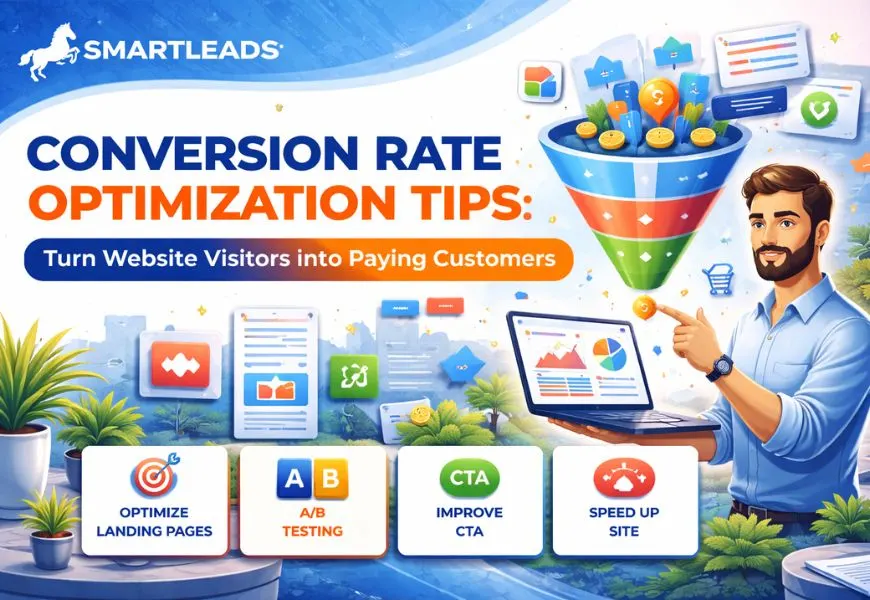
In today’s competitive digital landscape, driving traffic to your website is only half the battle. The real challenge lies in converting those visitors into paying customers. This is where conversion rate optimization tips become essential for businesses aiming to maximize their marketing efforts and increase revenue.
Conversion Rate Optimization (CRO) focuses on improving your website’s ability to turn visitors into leads or customers. Instead of spending more on traffic, CRO helps you get better results from your existing audience. In this blog, we’ll explore proven strategies to boost conversions and drive measurable business growth.
Why Conversion Rate Optimization Matters
Many businesses invest heavily in marketing but overlook conversion optimization.
Effective conversion rate optimization tips help:
- Increase revenue without increasing traffic
- Improve user experience
- Reduce customer acquisition costs
- Maximize return on investment (ROI)
- Generate more qualified leads
Even small improvements in conversion rates can significantly impact your overall business performance.
Step 1: Understand Your Audience Behaviour
The foundation of CRO is understanding how users interact with your website.
Use tools like analytics and heatmaps to analyze:
- User navigation patterns
- Drop-off points
- Pages with high bounce rates
Understanding user behaviour helps identify areas where improvements are needed.
Step 2: Create a Clear Value Proposition
Your website should clearly communicate what you offer and why it matters.
A strong value proposition includes:
- Clear headline
- Problem-solving message
- Unique selling points (USPs)
Visitors should immediately understand how your product or service benefits them.
Step 3: Optimize Website Design and User Experience
A well-designed website improves engagement and conversions.
Focus on:
- Clean and simple layout
- Easy navigation
- Mobile responsiveness
- Fast loading speed
A smooth user experience keeps visitors engaged and encourages them to take action.
Step 4: Use Strong Call-to-Action (CTA)
CTAs guide users toward the desired action.
Effective CTAs should:
- Be clear and action-oriented
- Stand out visually
- Be placed strategically on the page
Examples include:
- “Get a Free Quote”
- “Book a Demo”
- “Start Your Free Trial”
Well-designed CTAs significantly improve conversion rates.
Step 5: Build Trust with Social Proof
Trust is a major factor in conversion.
Add elements such as:
- Customer testimonials
- Reviews and ratings
- Case studies
- Client logos
These trust signals reassure visitors and increase confidence in your brand.
Step 6: Optimize Landing Pages
Landing pages play a crucial role in conversions.
High-performing landing pages include:
- Focused messaging
- Minimal distractions
- Clear benefits
- Strong CTAs
- Lead capture forms
Aligning landing page content with your ads improves conversion rates.
Step 7: Reduce Friction in the Conversion Process
Complex processes can discourage users from completing actions.
To reduce friction:
- Simplify forms
- Reduce required fields
- Offer guest checkout options
- Minimize steps in the process
A seamless experience increases the likelihood of conversions.
Step 8: Use A/B Testing
A/B testing helps identify what works best.
Test variations of:
- Headlines
- CTAs
- Images
- Page layouts
By comparing different versions, businesses can optimize performance based on real data.
Step 9: Leverage Personalization
Personalized experiences improve engagement and conversions.
You can personalize:
- Content based on user behaviour
- Product recommendations
- Email campaigns
Personalization makes users feel valued and increases the chances of conversion.
Step 10: Track and Analyse Performance
Continuous improvement is key to CRO success.
Monitor key metrics such as:
- Conversion rate
- Bounce rate
- Average session duration
- Cost per conversion
Regular analysis helps identify opportunities for optimization and growth.
Final Thoughts
Conversion rate optimization tips are essential for turning website visitors into paying customers. By focusing on user experience, clear messaging, trust-building elements, and continuous testing, businesses can significantly improve their conversion rates.
CRO is not a one-time effort—it requires ongoing analysis and optimization. Businesses that adopt a data-driven approach can maximize their marketing ROI, reduce costs, and achieve sustainable growth. Instead of just increasing traffic, focus on converting the traffic you already have for better results.
FAQs
1. What is conversion rate optimization (CRO)?
Conversion rate optimization is the process of improving a website to increase the percentage of visitors who take a desired action, such as making a purchase or filling out a form.
2. Why is CRO important for businesses?
CRO helps businesses increase revenue without increasing traffic, improve user experience, and maximize return on investment.
3. How can I improve my website’s conversion rate?
You can improve conversions by optimizing CTAs, simplifying forms, improving website design, and using data-driven strategies like A/B testing.
4. What tools are used for conversion rate optimization?
Common tools include Google Analytics, heatmap tools, A/B testing platforms, and user behavior tracking tools.
5. How long does it take to see results from CRO?
CRO improvements can show results within weeks, but long-term success requires continuous testing and optimization.