
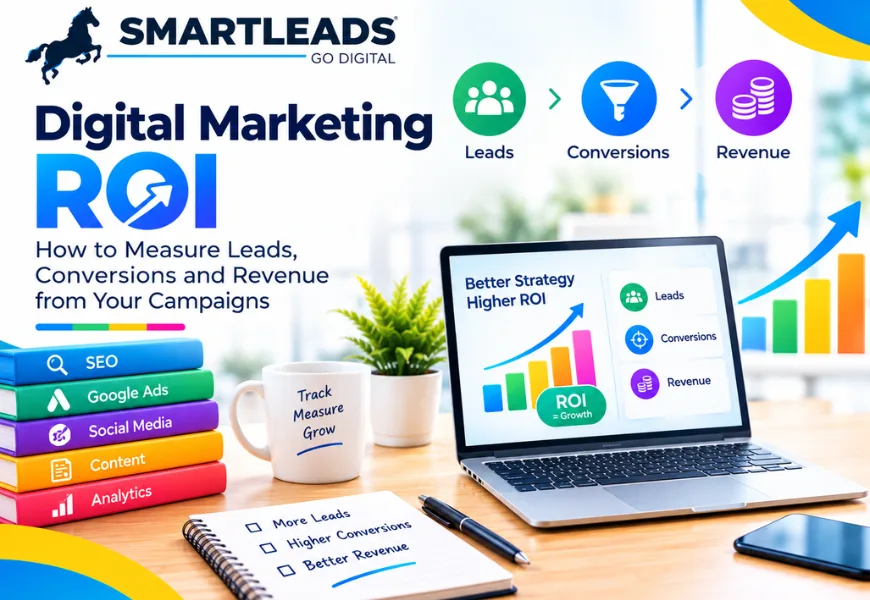
Digital marketing gives businesses access to more data than traditional marketing. You can track website visits, clicks, impressions, leads, conversions and sales. But collecting data is not the same as understanding whether your marketing is actually generating business growth.
This is where Digital Marketing ROI becomes important.
Instead of asking only, “How much traffic did we get?”, businesses should ask:
“How much revenue did our marketing investment generate?”
A strong ROI measurement strategy helps businesses identify profitable channels, improve campaigns, control unnecessary spending and make better marketing decisions.
What Is Digital Marketing ROI?
Digital Marketing ROI is a measure of the financial return a business receives from its digital marketing investment.
A basic ROI formula is:
ROI = (Revenue Generated − Marketing Cost) ÷ Marketing Cost × 100
For example, if a campaign generates ₹2,00,000 in attributable revenue from a ₹50,000 marketing investment, the ROI is 300%.
However, revenue attribution can be complex, especially when customers interact with multiple channels before making a purchase. Businesses should therefore consider the complete customer journey rather than relying on a single metric.
Why Is Measuring Digital Marketing ROI Important?
Without ROI measurement, businesses may continue spending money on campaigns that generate traffic but few customers.
Measuring ROI helps answer questions such as:
- Which marketing channel generates the most qualified leads?
- Which campaigns produce the highest-value customers?
- How much does it cost to acquire a customer?
- Which keywords generate conversions?
- Which landing pages perform best?
- Which campaigns should receive more budget?
The goal is to move from marketing activity to measurable business outcomes.
1. Track Leads, Not Just Website Traffic
Website traffic is useful, but traffic alone does not guarantee revenue.
For lead-generation businesses, track actions such as:
- Contact-form submissions
- Phone calls
- Consultation bookings
- Demo requests
- Quote requests
- WhatsApp enquiries
- Downloads
A website receiving 10,000 visitors but generating only a few relevant enquiries may be less effective than a website receiving 2,000 visitors with a strong conversion rate.
2. Measure Conversion Rate
Conversion rate measures the percentage of visitors who complete a desired action.
The basic formula is:
Conversion Rate = Conversions ÷ Total Visitors × 100
For example, if 1,000 people visit a landing page and 40 submit an enquiry, the conversion rate is 4%.
Businesses should measure conversion rates for different channels, campaigns and landing pages to identify where improvements are needed.
3. Calculate Cost Per Lead
Cost Per Lead, or CPL, helps businesses understand how much they spend to generate each lead.
CPL = Total Marketing Cost ÷ Number of Leads
For example, spending ₹50,000 to generate 100 leads results in a CPL of ₹500.
But a low CPL does not automatically mean a campaign is successful.
If most of those leads are irrelevant, the campaign may have poor business value.
This is why cost per qualified lead can be more useful than cost per lead alone.
4. Measure Customer Acquisition Cost
Customer Acquisition Cost, or CAC, measures how much it costs to acquire a customer.
CAC = Total Sales and Marketing Costs ÷ Number of New Customers
CAC helps businesses understand whether their marketing and sales investment is sustainable.
For example, a campaign might generate leads at a low cost but require significant sales effort to convert those leads into customers.
Understanding CAC provides a more complete picture of marketing performance.
5. Measure Revenue and Return on Ad Spend
For paid advertising, businesses can also monitor Return on Ad Spend (ROAS).
ROAS = Revenue Attributed to Advertising ÷ Advertising Cost
For example, if a business spends ₹20,000 on advertising and attributes ₹80,000 in revenue to those ads, the ROAS is 4:1.
ROAS can be useful for evaluating advertising efficiency, but it should not be viewed in isolation. Profit margins, operating costs and customer lifetime value also matter.
6. Measure Customer Lifetime Value
Some customers make one purchase. Others continue buying for years.
Customer Lifetime Value (CLV) estimates the total value a customer may generate throughout the relationship with a business.
Comparing CLV with customer acquisition cost can help businesses determine whether their marketing investment is sustainable.
A campaign with a relatively high acquisition cost may still be profitable if it consistently brings customers with high long-term value.
7. Track ROI Across Marketing Channels
Businesses often use multiple digital channels, including:
- SEO
- Google Ads
- Social media marketing
- Email marketing
- Content marketing
- AEO
- Local SEO
- Marketing automation
Each channel can contribute differently to the customer journey.
For example:
SEO → Website visit → Email signup → Remarketing → Sales enquiry → Customer
If businesses only credit the final interaction, they may undervalue the earlier marketing activities that helped create demand.
8. Use Analytics and Conversion Tracking
Accurate tracking is the foundation of ROI measurement.
Businesses should establish conversion tracking for important actions and connect marketing data with sales information wherever possible.
Useful data can include:
Traffic → Leads → Qualified Leads → Opportunities → Customers → Revenue
This creates a clearer connection between marketing investment and business results.
Digital Marketing ROI and AEO
As search evolves, businesses should also consider how AEO and AI-powered search visibility contribute to the customer journey.
A person may discover a business through an AI-generated answer, later search for the brand on Google and eventually convert through the company’s website.
This makes attribution more complicated.
Businesses should therefore avoid evaluating AEO, SEO or content marketing purely on immediate last-click conversions. Brand visibility, assisted conversions and qualified traffic can also provide valuable signals.
What Should Businesses Measure?
A practical digital marketing ROI dashboard can include:
| Metric | What It Shows |
| Traffic | Website visibility |
| Leads | Potential customers generated |
| Qualified Leads | Sales-relevant prospects |
| Conversion Rate | Website or campaign efficiency |
| CPL | Cost of generating leads |
| CAC | Cost of acquiring customers |
| ROAS | Advertising revenue efficiency |
| CLV | Long-term customer value |
| Revenue | Business outcome |
| ROI | Overall return on investment |
Final Thoughts
Digital Marketing ROI is about connecting marketing activity to real business outcomes.
Traffic, impressions and clicks can provide useful insights, but they should not be the final measure of success. Businesses need to understand the complete journey from visibility → traffic → leads → qualified opportunities → customers → revenue.
By tracking conversion rates, cost per lead, customer acquisition cost, ROAS, customer lifetime value and overall ROI, businesses can make smarter decisions about where to invest their marketing budget.
The strongest digital marketing strategy is not necessarily the one that generates the most traffic. It is the one that consistently generates valuable customers and measurable revenue.
Smart Leads Digital can help businesses build a measurable digital marketing strategy using SEO, AEO, Google Ads, social media marketing, lead generation, conversion optimization and marketing analytics, with a focus on turning online visibility into sustainable business growth.
FAQs
1. What is Digital Marketing ROI?
Digital Marketing ROI measures the financial return generated from digital marketing investments. It compares the value generated by marketing with the cost of the marketing activity.
2. How do you calculate Digital Marketing ROI?
A basic formula is (Revenue Generated − Marketing Cost) ÷ Marketing Cost × 100. Businesses should use reliable attribution data when determining which revenue can reasonably be connected to marketing activities.
3. What is more important: leads or revenue?
Revenue is generally the stronger business outcome, but qualified leads are important leading indicators. Businesses should track the complete journey from lead generation through sales and revenue.
4. How can businesses improve Digital Marketing ROI?
Improve targeting, focus on high-intent audiences, optimize landing pages, strengthen conversion tracking, reduce wasted advertising spend and invest more in channels that consistently generate qualified customers.
5. Can SEO and AEO have measurable ROI?
Yes, although measurement can be more complex than direct-response advertising. Businesses can monitor organic traffic, qualified leads, conversions, branded searches, assisted conversions and revenue influenced by organic and AI-search visibility.