
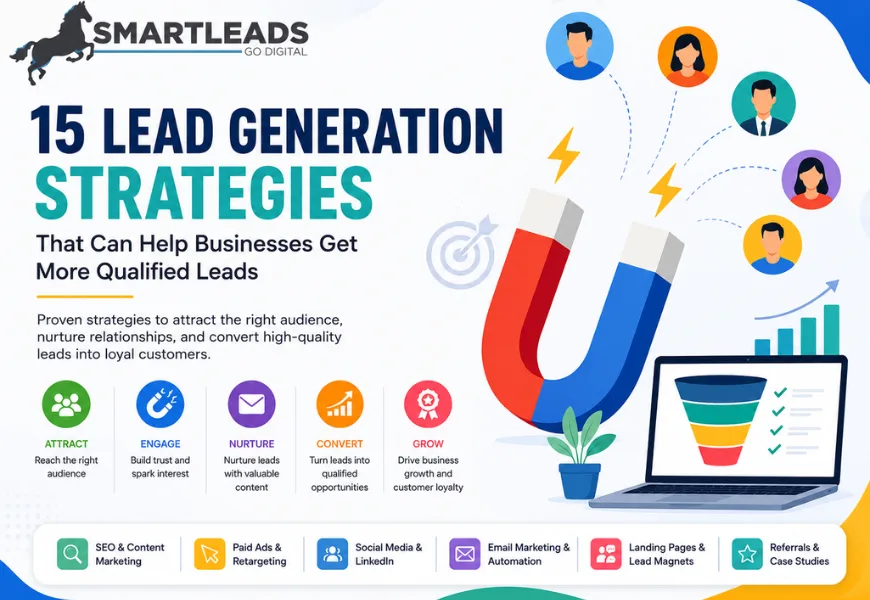
Generating leads is one of the biggest priorities for businesses looking to grow. But getting a large number of enquiries is not enough. The real goal is to attract qualified leads people who are genuinely interested in your products or services and are more likely to become customers.
So, what are the best lead generation strategies for businesses? A combination of SEO, content marketing, paid advertising, social media, email marketing, landing page optimization, and customer-focused campaigns can create a consistent flow of potential customers.
Here are 15 practical lead generation strategies businesses can use to attract, nurture, and convert better-quality leads.
What Is Lead Generation?
Lead generation is the process of attracting potential customers and encouraging them to share their contact information or take an action that indicates interest in a product or service.
Common lead-generation actions include:
- Filling out a contact form
- Requesting a quotation
- Booking a consultation
- Calling a business
- Signing up for a newsletter
- Downloading a guide
- Registering for a webinar
- Starting a free trial
The objective is not simply to generate more leads, but to generate relevant leads that match your target customer profile.
15 Effective Lead Generation Strategies
1. Optimize Your Website for Conversions
Your website should make it easy for visitors to become leads. Use clear headlines, compelling value propositions, visible contact information, simple forms, and strong calls to action.
Instead of generic buttons such as “Submit,” consider action-oriented CTAs such as “Request a Free Consultation” or “Get a Quote.”
2. Invest in SEO
SEO helps your business appear when potential customers search for solutions related to your products or services.
Target keywords based on different stages of the buying journey, including informational, commercial, and transactional searches.
Creating dedicated service pages and useful blog content can help attract users who are already searching for what your business provides.
3. Use Local SEO
For businesses serving specific locations, local SEO can be a powerful lead-generation channel.
Optimize your Google Business Profile, location pages, business information, reviews, and locally relevant content. Appearing prominently for searches with local intent can put your business in front of customers who are ready to contact a provider.
4. Create High-Value Content
Content marketing can attract potential customers before they are ready to buy.
Create content that answers real customer questions, solves problems, and demonstrates your expertise. Useful formats include:
- How-to guides
- Industry reports
- Case studies
- Checklists
- Comparison articles
- Expert guides
- FAQs
For AEO, structure content around direct questions and concise answers so it can better serve users searching through AI-powered answer engines.
5. Use Google Ads for High-Intent Searches
Google Ads can help businesses reach people actively searching for specific products or services.
Focus campaigns on high-intent keywords and send visitors to dedicated landing pages rather than generic website pages. Track conversions to determine which campaigns generate qualified enquiries rather than simply clicks.
6. Build Dedicated Landing Pages
A landing page should have one clear purpose.
For example, if you are running an advertisement for SEO services, the landing page should focus specifically on SEO rather than presenting every service your agency offers.
A strong landing page typically includes:
- Clear headline
- Key benefits
- Relevant proof or testimonials
- Short enquiry form
- Strong CTA
- Answers to common objections
7. Use Social Media Lead Generation
Social media platforms can help businesses build awareness and generate direct enquiries.
Share educational content, customer success stories, product demonstrations, short videos, industry insights, and offers. Encourage users to visit your website, send a message, book a consultation, or complete a lead form.
8. Leverage LinkedIn for B2B Leads
For B2B companies, LinkedIn can be an effective platform for reaching decision-makers.
Publish valuable industry content, participate in relevant conversations, build professional relationships, and use targeted outreach carefully. Avoid sending generic sales messages to every connection.
Personalized communication generally creates stronger engagement than mass outreach.
9. Offer Lead Magnets
A lead magnet provides something valuable in exchange for a prospect’s contact information.
Examples include:
- Free guides
- Templates
- Ebooks
- Checklists
- Industry reports
- Webinars
- Free assessments
- Calculators
The lead magnet should solve a specific problem for your target audience.
10. Use Email Marketing
Email marketing allows businesses to nurture prospects who are not ready to purchase immediately.
Segment your audience and send relevant content based on their interests and stage in the buying journey. Educational emails, case studies, product information, and personalized offers can gradually move prospects toward conversion.
11. Publish Customer Case Studies
Case studies provide evidence that your product or service delivers real value.
Explain the customer’s challenge, the solution implemented, and the measurable outcome. This type of content can help prospects understand what working with your business could look like.
12. Use Retargeting Campaigns
Many website visitors do not convert during their first visit.
Retargeting allows businesses to reconnect with users who have previously interacted with their website or digital content, subject to applicable platform policies and privacy requirements.
Use retargeting to remind prospects about relevant services, content, offers, or consultations rather than repeatedly showing the same generic advertisement.
13. Add Live Chat and Conversational Tools
Some visitors have questions before submitting an enquiry.
Live chat, conversational forms, and AI-powered website assistants can help answer common questions and guide visitors toward relevant pages or actions. Make sure users can easily reach a human when their question requires personal assistance.
14. Use Referral Marketing
Existing customers can become an important source of new business.
Create a structured referral program where appropriate, and make it easy for satisfied customers to recommend your business. Referral leads often arrive with a higher level of trust because the introduction comes from someone they already know.
15. Measure Lead Quality, Not Just Lead Volume
Generating 500 leads does not necessarily mean a campaign is successful if most leads are irrelevant.
Track:
- Qualified leads
- Conversion rate
- Cost per lead
- Cost per qualified lead
- Customer acquisition cost
- Sales-qualified leads
- Revenue generated
- Return on marketing investment
This helps you identify which channels are actually contributing to business growth.
How Do You Choose the Right Lead Generation Strategy?
The best strategy depends on your business model, audience, industry, location, sales cycle, and budget.
For example:
- Local businesses: Local SEO, Google Ads, reviews, and location-based content
- B2B businesses: LinkedIn, SEO, case studies, email marketing, and webinars
- E-commerce businesses: SEO, paid advertising, social media, email marketing, and retargeting
- Professional services: SEO, educational content, referrals, Google Ads, and consultation landing pages
Rather than using every strategy at once, start with the channels most closely aligned with your target customers.
Final Thoughts
Effective lead generation strategies are about more than attracting attention. The goal is to connect your business with people who have a genuine need, provide them with useful information, and make the next step easy.
A strong lead-generation system combines SEO, content, paid advertising, social media, landing pages, email nurturing, referrals, and conversion optimization. Most importantly, measure the quality and revenue potential of your leads—not just the number of forms submitted.
Start with two or three strategies that match your audience, measure the results, and continuously improve your campaigns. Over time, this approach can help turn digital marketing from a source of traffic into a predictable engine for qualified business growth.
FAQs
1. What is the most effective lead generation strategy?
There is no single strategy that works for every business. SEO, Google Ads, content marketing, social media, email marketing, referrals, and landing page optimization can all be effective when matched to the right audience and business goals.
2. How can businesses generate more qualified leads?
Businesses can improve lead quality by targeting specific customer segments, using high-intent keywords, creating relevant landing pages, qualifying enquiries, and tracking conversions beyond the initial lead.
3. Is SEO good for lead generation?
Yes. SEO can attract people actively searching for solutions related to a business’s products or services. Service pages, local SEO, commercial keywords, and helpful content can all contribute to organic lead generation.
4. How can I reduce my cost per lead?
Improve targeting, optimize landing pages, test advertisements and keywords, remove low-performing campaigns, strengthen conversion rates, and focus on qualified leads rather than maximizing lead volume alone.
5. How long does it take to see results from lead generation?
The timeline depends on the strategy. Paid advertising can produce enquiries relatively quickly, while SEO, content marketing, referrals, and organic social media generally require consistent effort over a longer period.