
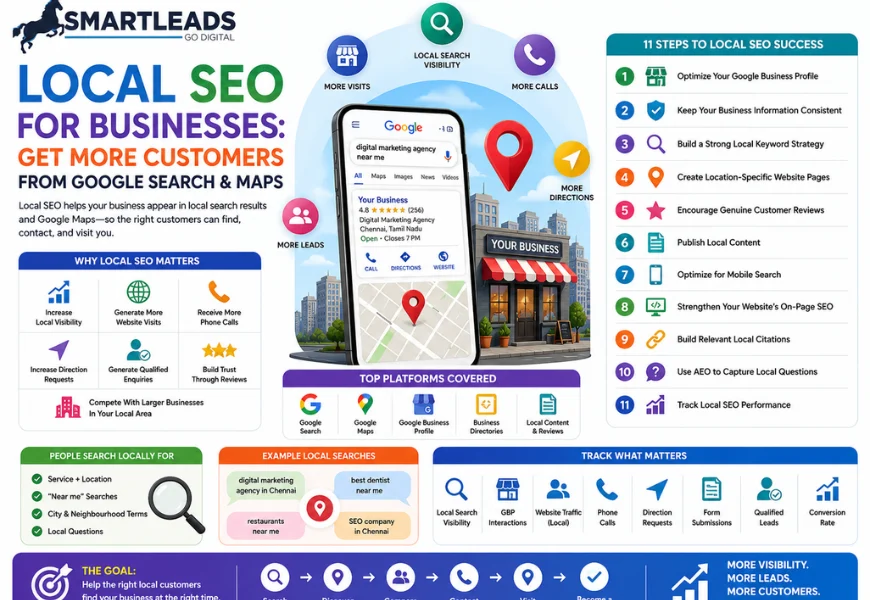
For businesses that serve a specific city, neighbourhood, or service area, being visible when nearby customers search online can make a significant difference. Local SEO helps businesses improve their visibility in local search results and Google Maps, making it easier for potential customers to discover, contact, and visit them.
Whether you run a restaurant, clinic, retail store, professional service, home-service company, or local agency, a well-planned local SEO strategy can help turn nearby searches into real enquiries and customers.
What Is Local SEO?
Local SEO is the process of optimizing a business’s online presence so it can appear more prominently for searches with local intent.
For example, someone searching for “digital marketing agency near me,” “best dentist in Chennai,” or “restaurants near me” is showing local intent.
Local SEO focuses on improving visibility across:
- Google Search
- Google Maps
- Google Business Profile
- Local business directories
- Location-specific website pages
- Customer reviews
- Local content
The objective is simple: help the right local customers find your business at the right time.
Why Is Local SEO Important for Businesses?
Consumers increasingly use search engines to find businesses nearby. They may search for a service, compare providers, read reviews, check opening hours, or look for directions before making a decision.
A strong local SEO presence can help businesses:
- Increase local visibility
- Generate more website visits
- Receive more phone calls
- Increase direction requests
- Generate qualified enquiries
- Build trust through reviews
- Compete with larger businesses in specific locations
Local SEO is particularly valuable for businesses where location influences the buying decision.
1. Optimize Your Google Business Profile
One of the most important steps in local SEO is creating and maintaining an accurate Google Business Profile.
Make sure your profile includes:
- Correct business name
- Accurate address or service area
- Phone number
- Website
- Business category
- Opening hours
- Relevant services
- High-quality images
- Business description
Keep your information accurate and update it when details change.
Your business category should accurately represent what your company does because it helps Google understand which searches your business may be relevant for.
2. Keep Your Business Information Consistent
Your business name, address, and phone number should be consistent across your website and relevant online directories.
Inconsistent information can create confusion for customers and search engines.
Review important business listings periodically and update outdated information, particularly after a change of address, phone number, website, or business name.
3. Build a Strong Local Keyword Strategy
Local keyword research helps you understand how potential customers search for your products or services.
Target relevant combinations of:
- Service + location
- Product + location
- “Near me” searches
- City-specific terms
- Neighbourhood terms
- Local questions
For example, a digital marketing agency might target terms such as “digital marketing agency in Chennai,” “SEO company in Chennai,” and other relevant service-location combinations.
Avoid forcing keywords into content. Use them naturally while making the page genuinely useful to visitors.
4. Create Location-Specific Website Pages
If your business operates across multiple locations, dedicated location pages can help target relevant local searches.
A useful location page should provide genuine information about the services available in that area rather than simply replacing a city name throughout the same template.
Include:
- Services offered
- Areas served
- Local customer needs
- Relevant FAQs
- Contact information
- Directions where appropriate
- Customer reviews or case studies
This gives both users and search engines more context about your local presence.
5. Encourage Genuine Customer Reviews
Reviews are an important part of local business visibility and customer decision-making.
Encourage satisfied customers to leave honest reviews on your Google Business Profile and other relevant platforms.
Respond professionally to both positive and negative feedback. Avoid buying reviews or creating fake testimonials, as authenticity matters for long-term trust.
6. Publish Local Content
Local content can help demonstrate relevance to your target market.
For example, a digital marketing agency could create articles such as:
- Digital Marketing Strategies for Chennai Businesses
- How Local SEO Helps Small Businesses
- Google Ads for Local Businesses
- How to Generate Leads in Chennai
The best local content addresses genuine customer questions rather than simply inserting city names into generic articles.
7. Optimize for Mobile Search
Many local searches happen on smartphones. Your website should therefore provide a smooth mobile experience.
Make sure visitors can quickly:
- Read your content
- Find your phone number
- Submit an enquiry
- Access directions
- Navigate your website
- Understand your services
A slow or difficult mobile website can cause potential customers to leave before contacting you.
8. Strengthen Your Website’s On-Page SEO
Your local landing pages should have clear, useful information and appropriate SEO elements.
Pay attention to:
- Page titles
- Meta descriptions
- Headings
- URL structure
- Internal links
- Image alt text
- Service information
- Location relevance
Don’t create pages purely for search engines. Build pages that answer the questions potential customers have before contacting your business.
9. Build Relevant Local Citations
Local citations are online mentions of your business, often including information such as its name, address, and phone number.
Relevant business directories, industry websites, local organizations, and reputable platforms can help strengthen your online presence.
Quality and relevance matter more than submitting your business to hundreds of low-quality directories.
10. Use AEO to Capture Local Questions
Local SEO and Answer Engine Optimization can work together.
People increasingly search using conversational questions such as:
- “What is the best SEO company near me?”
- “How much does local SEO cost?”
- “Which digital marketing agency is best for small businesses?”
- “How can I improve my Google Maps ranking?”
Create clear answers to these questions on your website. Use descriptive headings, concise explanations, FAQs, supporting evidence, and structured information.
This makes your content easier for users—and potentially AI-powered search experiences—to understand.
11. Track Local SEO Performance
Local SEO should be measured regularly.
Monitor metrics such as:
- Local search visibility
- Google Business Profile interactions
- Website traffic from local searches
- Phone calls
- Direction requests
- Form submissions
- Qualified leads
- Local keyword rankings
- Conversion rate
The goal isn’t simply to rank for a keyword. The goal is to generate meaningful business results.
Final Thoughts
Local SEO for businesses is about becoming visible when potential customers are actively looking for what you offer. A strong strategy combines Google Business Profile optimization, local keywords, location pages, reviews, relevant content, mobile optimization, citations, and conversion-focused website improvements.
Don’t focus only on rankings. Focus on the complete customer journey—from “near me” search to website visit, phone call, enquiry, and purchase.
When local SEO is combined with useful content and AEO principles, your business can build stronger local visibility, answer customer questions more effectively, and create more opportunities to turn local searches into real customers.
FAQs
1. What is local SEO and why is it important?
Local SEO improves a business’s visibility for location-based searches. It helps nearby customers discover businesses through Google Search, Google Maps, and other online platforms.
2. How can I improve my Google Maps visibility?
Start by maintaining an accurate Google Business Profile, selecting the appropriate business category, keeping business information consistent, collecting genuine reviews, adding relevant content and images, and building a strong local website presence.
3. How long does local SEO take to work?
Results vary depending on competition, location, website quality, business authority, and the consistency of optimization. Some improvements may appear relatively quickly, while stronger local visibility usually requires ongoing effort.
4. Is local SEO useful for small businesses?
Yes. Local SEO can be especially valuable for small businesses because it allows them to target customers in specific geographic areas rather than competing for broad national searches.
5. How much does local SEO cost?
Local SEO costs vary depending on the business’s location, competition, number of locations, services required, and scope of work. A basic local SEO campaign may focus on Google Business Profile and on-page optimization, while competitive markets may require ongoing content, reputation management, technical SEO, and authority-building work.