
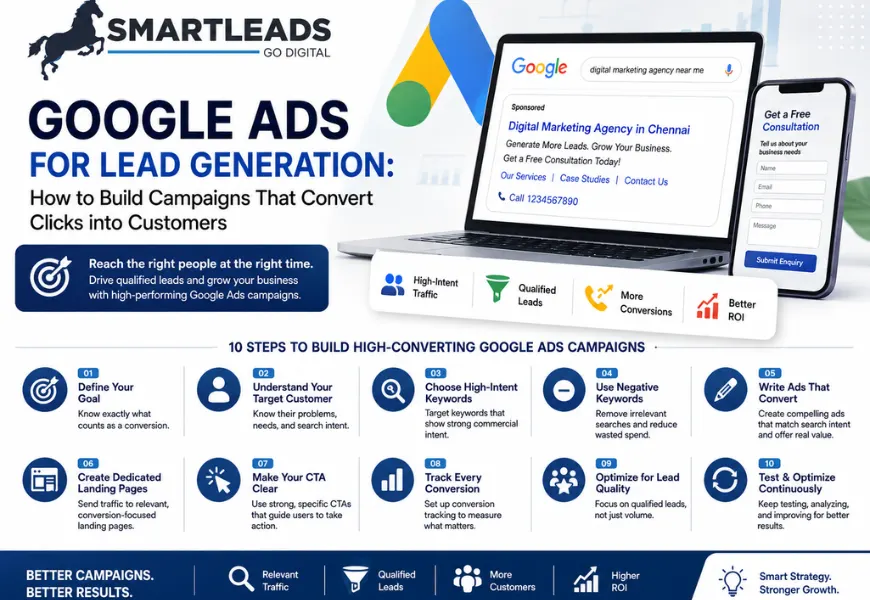
For businesses looking for immediate visibility and qualified enquiries, Google Ads can be a powerful lead generation channel. Unlike many forms of advertising, Google Ads can put your business in front of people who are actively searching for a product, service, or solution.
However, getting clicks is not the same as generating customers. A successful Google Ads lead generation campaign requires the right keywords, compelling advertisements, relevant landing pages, accurate conversion tracking, and continuous optimization.
This guide explains how businesses can build Google Ads campaigns that turn search traffic into qualified leads and customers.
What Is Google Ads Lead Generation?
Google Ads lead generation is the process of using paid Google advertising to attract potential customers and encourage them to take a valuable action, such as submitting a form, calling a business, booking a consultation, requesting a quote, or signing up for a service.
For example, someone searching for “digital marketing agency for small business” already has a potential need. A relevant Google Search ad can introduce the business at the moment that person is actively looking for a solution.
The goal is therefore not simply to maximize clicks. It is to attract high-intent users who are more likely to convert.
Why Use Google Ads for Lead Generation?
Google Ads can provide several advantages for businesses:
- Immediate search visibility
- Precise keyword targeting
- Geographic targeting
- Budget control
- Measurable conversions
- Ability to reach high-intent prospects
- Flexible campaign testing
- Data for ongoing optimization
When campaigns are structured correctly, businesses can identify which keywords, advertisements, audiences, and landing pages generate the best results.
1. Define Your Lead Generation Goal
Before creating a campaign, determine exactly what counts as a conversion.
Your conversion goal could be:
- Contact form submission
- Phone call
- Consultation booking
- Quote request
- Demo request
- Product enquiry
- Purchase
- Lead form submission
A clear conversion goal allows you to measure campaign performance accurately.
2. Understand Your Target Customer
Google Ads works best when you understand who you want to reach.
Identify:
- Your ideal customer
- Their main problems
- Products or services they need
- Locations they serve
- Search terms they may use
- Their likely buying stage
- Reasons they may choose a competitor
This information helps you create advertisements that match actual customer intent.
3. Choose High-Intent Keywords
Keyword selection is one of the most important parts of search advertising.
Focus on keywords that indicate commercial or transactional intent.
For example, searches such as:
- SEO agency for small business
- digital marketing agency Chennai
- Google Ads management services
- business consultant near me
may show stronger commercial intent than broad informational searches such as “what is digital marketing?”
Use keyword research to identify relevant search terms, and review actual search queries regularly to discover irrelevant traffic.
4. Use Negative Keywords
Negative keywords help prevent advertisements from appearing for searches that are not relevant to your business.
For example, a paid digital marketing service provider might exclude searches containing terms such as “free course,” “jobs,” or “salary” if those users are not potential customers.
Regularly reviewing search terms can help reduce wasted advertising spend and improve lead quality.
5. Write Ads That Match Search Intent
Your advertisement should immediately communicate why the user should choose your business.
A strong search ad can highlight:
- Relevant service
- Main customer benefit
- Unique value proposition
- Location
- Experience or credibility
- Clear call to action
Avoid making unsupported claims. Instead, focus on specific benefits that are genuinely available.
For example, instead of simply writing “Digital Marketing Services,” a more compelling message could emphasize a clear outcome such as “Generate More Qualified Leads With Performance-Focused Digital Marketing.”
6. Create Dedicated Landing Pages
One of the most common mistakes in Google Ads is sending every visitor to the homepage.
Instead, create a landing page that closely matches the advertisement and keyword.
A strong lead-generation landing page should include:
- Clear headline
- Relevant service information
- Benefits
- Social proof
- Testimonials or case studies
- Frequently asked questions
- Simple enquiry form
- Strong CTA
- Contact information
The closer the relationship between the keyword, ad, and landing page, the more relevant the user experience can become.
7. Make Your Call to Action Clear
Don’t make visitors guess what to do next.
Use specific CTAs such as:
- Request a Consultation
- Get a Free Quote
- Book a Strategy Call
- Request a Demo
- Talk to an Expert
- Get Started Today
Your CTA should match the user’s stage in the buying journey.
8. Track Every Important Conversion
Conversion tracking is essential for measuring Google Ads performance.
Track actions such as:
- Form submissions
- Phone calls
- Bookings
- Purchases
- Qualified leads
Whenever possible, connect advertising data with CRM or sales data so you can understand which campaigns produce actual customers rather than just leads.
9. Optimize for Lead Quality
A campaign generating 100 low-quality leads may be less valuable than one generating 20 highly qualified prospects.
Monitor:
- Cost per lead
- Cost per qualified lead
- Conversion rate
- Lead-to-customer rate
- Customer acquisition cost
- Revenue generated
- Return on ad spend
Work with the sales team to identify which leads are genuinely valuable.
10. Test and Optimize Continuously
Google Ads should not be treated as a set-and-forget marketing channel.
Regularly test:
- Keywords
- Search terms
- Advertisements
- Landing pages
- CTAs
- Geographic targeting
- Audience signals
- Bidding strategies
- Budget allocation
Use performance data to make informed decisions rather than changing multiple variables without a clear reason.
Google Ads and AEO: How Do They Work Together?
Google Ads and Answer Engine Optimization serve different purposes, but they can complement each other.
Google Ads provides paid visibility for targeted searches, while AEO focuses on creating content that clearly answers questions users ask across search engines and AI-powered answer platforms.
For example, businesses can create organic content answering questions such as:
- How much does Google Ads cost?
- Is Google Ads good for lead generation?
- How do I reduce cost per lead?
- What is the difference between Google Ads and SEO?
This combination can help businesses capture customers across different stages of the buying journey.
Final Thoughts
Google Ads for lead generation is most effective when every part of the campaign works together—from keyword selection and ad copy to landing pages, conversion tracking, and sales follow-up.
Don’t measure success by clicks alone. Focus on qualified leads, customers, revenue, cost per acquisition, and overall return on advertising investment.
Start with a focused campaign targeting high-intent searches, build a relevant landing page, track meaningful conversions, and continuously optimize based on real performance data. With a disciplined approach, Google Ads can become a predictable channel for generating qualified business opportunities.
FAQs
1. Is Google Ads effective for lead generation?
Yes. Google Ads can be effective because businesses can target users actively searching for relevant products or services. Results depend on keyword selection, ad relevance, landing-page quality, budget, competition, and conversion optimization.
2. How much does Google Ads lead generation cost?
There is no fixed cost. Advertising costs vary by industry, keyword competition, location, audience, and campaign quality. Businesses should establish a target cost per qualified lead rather than focusing only on the cost per click.
3. How can I get better-quality leads from Google Ads?
Use high-intent keywords, relevant landing pages, negative keywords, accurate conversion tracking, clear qualification criteria, and ongoing search-term analysis. Connecting Google Ads with sales data can also help identify which campaigns generate valuable customers.
4. How long does it take for Google Ads to generate leads?
Search campaigns can begin receiving traffic soon after becoming active, but meaningful optimization generally requires enough conversion data. The timeline depends on search volume, budget, competition, targeting, and conversion rates.
5. Should a business use Google Ads or SEO for lead generation?
Google Ads can provide faster paid visibility, while SEO can build organic visibility over time. Many businesses benefit from combining both approaches to capture immediate demand while building sustainable long-term search traffic.