
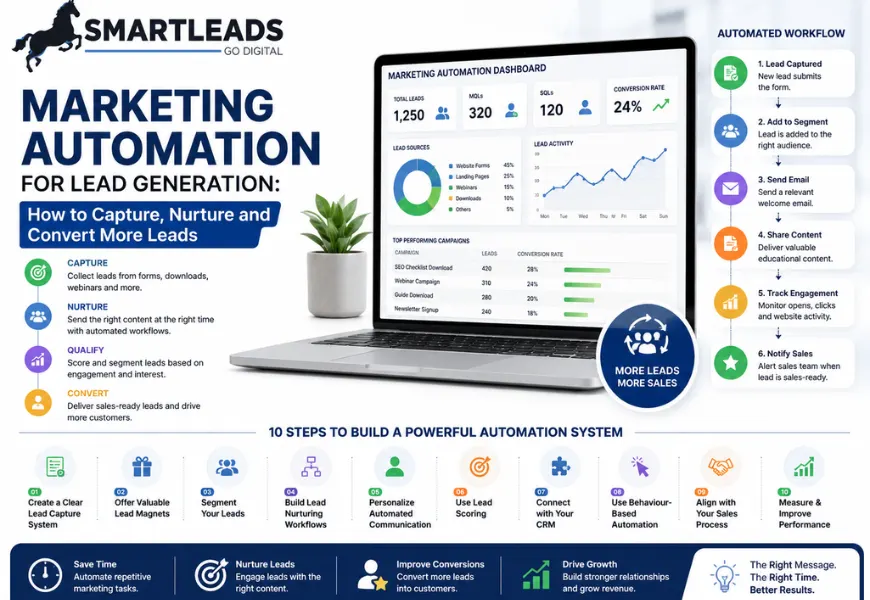
Generating leads is only the beginning of the customer journey. Many prospects are not ready to buy the moment they discover a business. Some need more information, others need time to compare options, and some may simply forget to follow up. This is where marketing automation for lead generation can make a significant difference.
Marketing automation helps businesses capture leads, organize prospect data, deliver relevant communication, and nurture potential customers at the right stage of the buying journey. When combined with a strong content and lead-generation strategy, automation can reduce manual work while creating a more consistent customer experience.
What Is Marketing Automation for Lead Generation?
Marketing automation for lead generation is the use of software and automated workflows to capture, segment, nurture, qualify, and convert potential customers.
Instead of manually following up with every prospect, businesses can create predefined workflows based on customer actions.
For example, when someone downloads a guide from your website, an automated system could:
- Capture their contact information.
- Add the prospect to the appropriate audience segment.
- Send a relevant follow-up email.
- Share useful educational content.
- Track engagement.
- Notify the sales team when the lead shows stronger buying intent.
The purpose is not to replace human communication. It is to make the process more organized, timely, and scalable.
Why Is Marketing Automation Important for Lead Generation?
Traditional lead generation often stops once someone submits a form. Marketing automation allows businesses to continue the conversation.
A well-designed automation strategy can help businesses:
- Respond to leads faster
- Nurture prospects consistently
- Segment audiences
- Personalize communication
- Identify high-intent leads
- Reduce repetitive marketing tasks
- Improve sales and marketing alignment
- Track customer interactions
- Increase conversion opportunities
For businesses handling hundreds or thousands of prospects, automation can become particularly valuable.
1. Create a Clear Lead Capture System
Automation starts with effective lead capture.
Your website should make it easy for visitors to take the next step through:
- Contact forms
- Consultation bookings
- Newsletter subscriptions
- Free resources
- Product demonstrations
- Quote requests
- Webinars
- Free assessments
Avoid asking for unnecessary information. A shorter, relevant form can make it easier for prospects to submit their details.
2. Offer Valuable Lead Magnets
People are more likely to share their information when they receive something genuinely useful in return.
Lead magnets can include:
- Ebooks
- Checklists
- Templates
- Industry reports
- Guides
- Webinars
- Case studies
- Free audits or assessments
For example, a digital marketing agency could offer a free SEO checklist for small businesses and use the download as the starting point for a lead-nurturing workflow.
3. Segment Your Leads
Not every prospect has the same needs.
Lead segmentation allows businesses to group prospects according to factors such as:
- Industry
- Location
- Service interest
- Company size
- Buying stage
- Website behaviour
- Previous interactions
For example, someone who downloads an SEO guide should not necessarily receive the same emails as someone who requests a consultation.
Segmentation makes automated communication more relevant.
4. Build Lead-Nurturing Workflows
A lead-nurturing workflow guides prospects through a series of relevant interactions.
A simple workflow might look like this:
Day 1: Send the requested resource.
Day 3: Share an educational article related to the prospect’s interest.
Day 6: Send a case study or customer success story.
Day 10: Explain your service and how it solves the customer’s problem.
Day 14: Offer a consultation or product demonstration.
The exact timing should depend on the buying cycle and audience rather than following a universal schedule.
5. Personalize Automated Communication
Automation should not feel robotic.
Use available customer information to personalize messages based on genuine interests and behaviour. Relevant subject lines, content recommendations, service information, and follow-up messages can make communication more useful.
However, personalization should be accurate and respectful. Avoid pretending to know information about a prospect that they have not provided.
6. Use Lead Scoring
Lead scoring helps businesses prioritize prospects based on their engagement and potential buying intent.
A business might assign scores based on actions such as:
- Visiting important service pages
- Downloading content
- Opening emails
- Clicking links
- Requesting pricing
- Booking a consultation
- Returning to the website
A high score can trigger an alert for the sales team, allowing them to focus on prospects who appear more ready for a conversation.
7. Connect Marketing Automation with Your CRM
Marketing automation becomes more powerful when connected to a CRM.
The integration can help teams maintain a clearer record of:
- Lead source
- Contact information
- Communication history
- Website activity
- Sales stage
- Follow-up status
- Conversion outcome
This helps marketing and sales teams work from a shared view of the customer journey.
8. Use Behaviour-Based Automation
Instead of sending identical messages to everyone, create workflows triggered by specific actions.
For example:
- A visitor downloads an ebook → send related content.
- A prospect visits a pricing page → offer a consultation.
- A customer completes a purchase → send onboarding information.
- A subscriber becomes inactive → send a re-engagement campaign.
Behaviour-based automation can make communication more timely and relevant.
9. Align Automation with Your Sales Process
Marketing automation should support the sales team rather than operate separately from it.
Define when a lead should move from marketing to sales. Establish clear criteria for a qualified lead and ensure sales representatives receive enough context to understand why the prospect is being contacted.
This can reduce delays and improve follow-up quality.
10. Measure and Improve Performance
Automation should be measured like any other marketing activity.
Track metrics such as:
- Lead capture rate
- Email engagement
- Marketing-qualified leads
- Sales-qualified leads
- Lead-to-customer conversion rate
- Cost per lead
- Customer acquisition cost
- Revenue generated
- Workflow conversion rate
These metrics help identify which workflows are creating genuine business value.
How Does Marketing Automation Support AEO?
Marketing automation and Answer Engine Optimization can work together as part of a broader digital marketing strategy.
AEO-focused content can answer questions prospects are asking, such as “How does marketing automation work?”, “Is marketing automation useful for small businesses?”, or “How can businesses nurture leads automatically?”
When visitors discover this content through search engines or AI-powered answer platforms, businesses can use relevant calls to action to move them into an appropriate lead-capture and nurturing workflow.
This creates a connected journey from search → useful answer → lead capture → nurturing → sales conversation.
Final Thoughts
Marketing automation for lead generation is not simply about sending automated emails. It is about creating a structured customer journey that captures interest, provides useful information, builds trust, and helps prospects move toward a purchase decision.
Start with a clear lead-capture process, segment your audience, create useful nurturing workflows, connect automation with your CRM, and define clear handoff points between marketing and sales.
Most importantly, keep the customer experience at the centre of the strategy. Automation works best when it delivers the right information to the right prospect at the right stage, while allowing your team to step in when human interaction matters most.
FAQs
1. What is marketing automation for lead generation?
Marketing automation uses software and automated workflows to capture, segment, nurture, qualify, and follow up with potential customers. It helps businesses manage leads more efficiently and consistently.
2. Can small businesses use marketing automation?
Yes. Small businesses can use automation for tasks such as email follow-ups, lead capture, appointment reminders, customer segmentation, and lead nurturing. The key is to start with workflows that solve clear business needs.
3. Does marketing automation replace sales teams?
No. Marketing automation supports sales teams by handling repetitive tasks and identifying prospects who may be ready for a sales conversation. Human interaction remains important for complex purchases and relationship-driven sales.
4. How does lead scoring improve lead generation?
Lead scoring helps businesses prioritize prospects according to their engagement and potential buying intent. Sales teams can focus their attention on leads that meet predefined qualification criteria.
5. What are the most important marketing automation metrics?
Important metrics include lead capture rate, qualified leads, conversion rate, customer acquisition cost, workflow performance, and revenue generated. The right metrics depend on the business model and campaign objectives.