
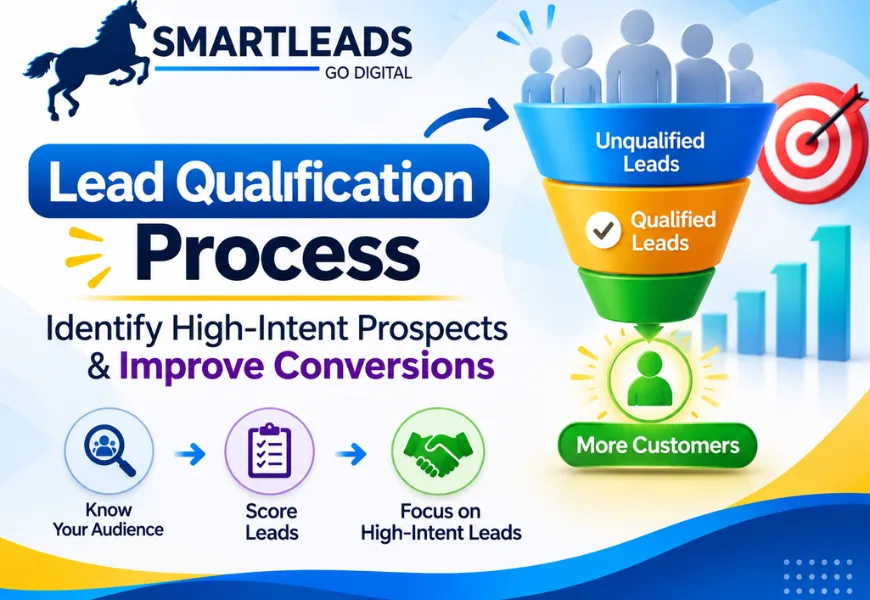
A lead qualification process is a structured method businesses use to evaluate potential customers and determine whether they are likely to purchase a product or service. It helps sales and marketing teams identify high-intent prospects, prioritise valuable enquiries and avoid spending time on leads that are unlikely to convert.
Generating a large number of leads does not always result in more sales. Some prospects may be researching options, while others may have a genuine requirement, a suitable budget and the authority to make a purchase.
An effective lead qualification process helps businesses distinguish between these prospects. By understanding customer needs, purchase intent, budget, decision-making authority and timelines, companies can improve sales efficiency, increase conversion rates and build a stronger sales pipeline.
1. Define Your Ideal Customer Profile
Before qualifying leads, businesses need to understand which customers are most suitable for their products or services.
An Ideal Customer Profile (ICP) describes the type of customer most likely to benefit from your offering.
For B2B businesses, consider:
- Industry and business size.
- Company location.
- Annual revenue or budget range.
- Business challenges and requirements.
- Decision-making structure.
- Need for your products or services.
For B2C businesses, consider customer needs, preferences, location, purchasing behaviour and affordability.
A clearly defined customer profile helps marketing teams attract relevant prospects and gives sales teams a consistent standard for evaluating enquiries.
2. Understand the Different Types of Leads
Not every lead is ready to make a purchase. Understanding lead categories helps businesses decide how and when to follow up.
- Marketing Qualified Lead (MQL): A prospect who has shown interest through marketing activities, such as downloading a guide, subscribing to a newsletter or engaging with relevant content.
- Sales Qualified Lead (SQL): A prospect assessed by the sales team and considered suitable for direct sales engagement.
- Product Qualified Lead (PQL): A prospect whose product usage or trial activity indicates potential buying interest, particularly for software businesses.
These categories help align marketing and sales teams. Businesses should define their own qualification criteria based on their sales model rather than assuming every enquiry is immediately sales-ready.
3. Evaluate Leads Using the BANT Framework
BANT is a widely used lead qualification framework that evaluates four important factors: Budget, Authority, Need and Timeline.
Budget: Does the prospect have a suitable budget for the solution?
Authority: Is the person contacting your business involved in the purchasing decision?
Need: Does your product or service solve a genuine business problem?
Timeline: When does the prospect expect to make a decision or begin implementation?
For example, a company enquiring about digital marketing services may have a clear requirement, an approved marketing budget and a plan to start within the next month. This prospect may deserve faster sales attention than someone simply requesting general information.
BANT is a useful starting point, but businesses should adapt it to their industry and avoid rejecting promising leads solely because one detail is not yet known.
4. Ask the Right Questions During Lead Qualification
Asking relevant questions helps sales teams understand a prospect’s requirements without making the conversation feel like an interrogation.
Useful questions include:
- What product or service are you looking for?
- What challenge are you trying to solve?
- Have you used a similar solution before?
- What is your expected budget range?
- When are you planning to make a decision?
- Who else is involved in the purchasing process?
Keep questions relevant to the customer’s situation. For complex B2B purchases, additional discussions may be needed to understand technical requirements, implementation expectations and approval processes.
The goal is to identify genuine buying interest while providing a positive customer experience.
5. Use Lead Scoring to Prioritise High-Intent Prospects
Lead scoring assigns values to prospects based on their characteristics and interactions with your business.
A simple lead scoring model may consider:
| Qualification factor | Example signal |
| Service requirement | Requests a specific service quotation |
| Engagement | Visits important service pages |
| Buying intent | Books a consultation |
| Budget | Confirms a suitable budget |
| Timeline | Plans to purchase soon |
| Decision authority | Involved in final approval |
Assign scores based on your business requirements and historical conversion data. Prospects with stronger buying signals can receive higher priority.
Lead scoring can be managed through CRM platforms and marketing automation tools. Review the scoring model regularly to ensure that high scores genuinely indicate better sales opportunities.
6. Track and Manage Leads Through a CRM
A Customer Relationship Management (CRM) system helps businesses organise prospect information, record conversations and monitor sales progress.
A CRM can help teams:
- Store contact details and enquiry history.
- Track lead sources and campaign performance.
- Assign leads to sales representatives.
- Record qualification information.
- Schedule follow-up activities.
- Monitor opportunities through the sales pipeline.
Without a structured system, businesses may miss enquiries, delay responses or contact the same prospect multiple times.
Choose a CRM that matches your business size, sales process and reporting requirements. Make sure the sales team updates lead status consistently.
7. Follow Up at the Right Time
Timely follow-up is important because interested prospects may contact several businesses while comparing their options.
Create a follow-up process based on lead intent and customer preferences.
For example:
- Respond promptly to high-intent enquiries.
- Schedule consultations for prospects with clear requirements.
- Send relevant information to prospects who need more time.
- Use email or phone follow-ups based on the customer’s preferred communication channel.
- Revisit longer-term prospects at an appropriate time.
Avoid sending repeated, irrelevant messages. Every follow-up should provide value, answer questions or help the prospect move towards a decision.
8. Align Marketing and Sales Teams
Marketing and sales teams should share a clear understanding of what makes a lead qualified.
Marketing teams focus on attracting relevant prospects through SEO, paid advertising, social media and content marketing. Sales teams evaluate enquiries, understand customer requirements and guide suitable prospects towards a purchase.
Establish shared qualification criteria and agree on when a lead should be passed from marketing to sales.
Regular meetings can help identify lead quality issues, campaign improvements and common customer objections. This feedback also helps marketing teams refine targeting and attract better prospects.
9. Measure Lead Qualification Performance
Tracking the right metrics helps businesses understand whether their qualification process is improving sales outcomes.
Important metrics include:
- Lead-to-MQL rate: Percentage of leads that become marketing-qualified leads.
- MQL-to-SQL rate: Percentage of marketing-qualified leads accepted by sales.
- Lead-to-customer conversion rate: Percentage of leads that become paying customers.
- Cost per qualified lead: Marketing cost associated with generating a qualified lead.
- Sales cycle length: Average time taken to convert a prospect into a customer.
Review these metrics regularly and identify where prospects are dropping out of the sales process. Use the findings to improve targeting, qualification questions, follow-up and sales communication.
FAQs
1. What is a lead qualification process?
A lead qualification process is a method of evaluating potential customers based on their needs, budget, purchase intent, decision-making authority and buying timeline to determine whether they are suitable sales prospects.
2. Why is lead qualification important for businesses?
Lead qualification helps businesses prioritise high-intent prospects, reduce wasted sales effort, improve marketing efficiency and focus resources on enquiries with a stronger likelihood of becoming customers.
3. What is the BANT framework in lead qualification?
BANT stands for Budget, Authority, Need and Timeline. It is a framework used by sales teams to evaluate whether a prospect has the financial capacity, decision-making involvement, business requirement and purchase timeline for a solution.
4. Which tools help businesses qualify leads?
CRM platforms, marketing automation tools, lead scoring systems, website analytics and enquiry management software can help businesses collect prospect information, track engagement and prioritise sales opportunities.
5. How can businesses improve their lead qualification process?
Define an ideal customer profile, establish clear qualification criteria, ask relevant questions, use lead scoring, maintain accurate CRM records and follow up promptly. Review conversion data regularly to improve the process.
Final Thoughts
An effective lead qualification process helps businesses focus on prospects who have genuine requirements and a stronger likelihood of purchasing. Instead of treating every enquiry equally, companies can use customer profiles, qualification frameworks, lead scoring and CRM systems to prioritise valuable opportunities.
The process should also connect marketing and sales teams through shared goals, consistent communication and measurable performance indicators. With continuous improvement, businesses can reduce wasted effort, improve conversion rates and build a more predictable sales pipeline.
Smart Leads Digital helps businesses strengthen their online presence through SEO, AEO, paid advertising, social media marketing and lead generation strategies. By combining effective digital marketing with a structured lead qualification approach, businesses can attract relevant prospects and turn more enquiries into meaningful customer relationships.