
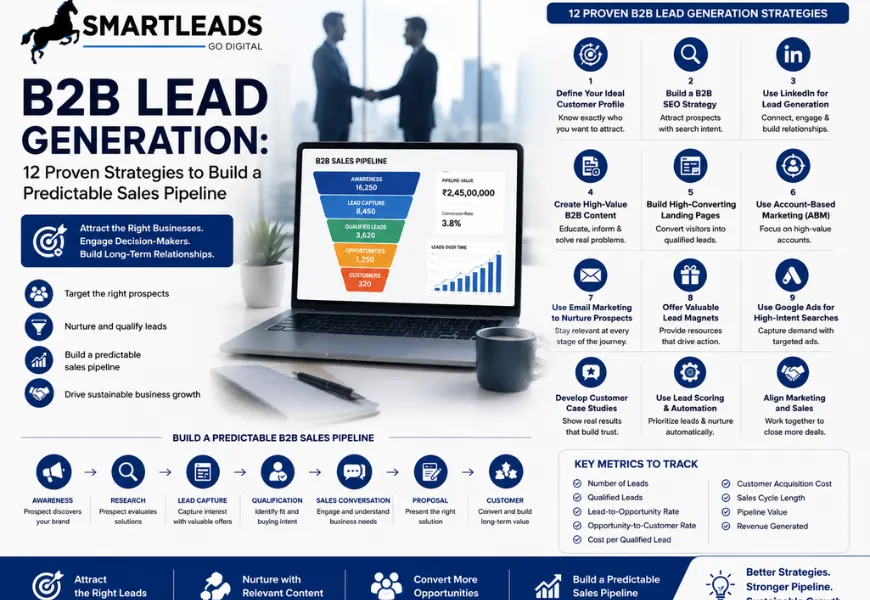
For B2B companies, generating leads is rarely about getting the highest possible number of enquiries. The real challenge is finding businesses and decision-makers that have a genuine need, the right budget, and the potential to become long-term customers.
A strong B2B lead generation strategy helps companies consistently attract relevant prospects, nurture relationships, qualify opportunities, and move them through the sales pipeline. When marketing and sales work together and performance is measured properly, lead generation can become a more predictable source of business growth.
What Is B2B Lead Generation?
B2B lead generation is the process of identifying, attracting, engaging, and qualifying potential business customers for a company’s products or services.
Unlike B2C purchases, B2B buying decisions often involve:
- Multiple decision-makers
- Longer sales cycles
- Higher-value transactions
- Detailed product or service evaluations
- Multiple conversations before purchase
Because of this, B2B lead generation requires more than simply collecting contact details. Businesses need to build trust and provide useful information throughout the buying journey.
12 Proven B2B Lead Generation Strategies
1. Define Your Ideal Customer Profile
Before generating leads, identify exactly which businesses you want to attract.
Your Ideal Customer Profile (ICP) can include:
- Industry
- Company size
- Location
- Revenue range
- Business needs
- Technology used
- Decision-maker roles
- Common challenges
A clearly defined ICP helps marketing teams avoid wasting resources on prospects that are unlikely to become customers.
2. Build a B2B-Focused SEO Strategy
SEO can help B2B companies attract potential customers while they are researching solutions.
Target keywords based on different stages of the buying journey, including:
- Problem-based searches
- Service-related searches
- Comparison keywords
- Pricing searches
- Solution-based questions
Create service pages, industry pages, guides, comparison articles, and FAQs that address genuine customer needs.
3. Use LinkedIn for B2B Lead Generation
LinkedIn can be particularly valuable for B2B companies because professionals and decision-makers actively use the platform.
Businesses can use LinkedIn to:
- Publish industry insights
- Share case studies
- Build professional relationships
- Engage with relevant communities
- Promote useful resources
- Run targeted advertising campaigns
Avoid relying entirely on promotional posts. Educational and problem-solving content can help establish credibility.
4. Create High-Value B2B Content
B2B buyers often conduct extensive research before contacting a company.
Useful content can include:
- Industry reports
- Whitepapers
- Case studies
- Research-based guides
- Webinars
- Comparison articles
- Expert interviews
- Checklists
For AEO, structure content around specific questions prospects ask. Clear answers can help your website become a useful source for both traditional search and AI-powered search experiences.
5. Build High-Converting Landing Pages
A landing page designed specifically for a B2B campaign can improve lead-generation performance.
Include:
- A clear value proposition
- Specific business benefits
- Relevant proof
- Customer testimonials
- Case studies
- Concise forms
- Strong calls to action
- Frequently asked questions
The landing page should closely match the advertisement, search query, or content that brought the visitor there.
6. Use Account-Based Marketing
Account-Based Marketing (ABM) focuses marketing efforts on specific high-value companies rather than targeting a broad audience.
Identify priority accounts, research their needs, create relevant messaging, and coordinate marketing and sales outreach.
ABM can be particularly useful for businesses selling complex or high-value B2B solutions.
7. Use Email Marketing to Nurture Prospects
Many B2B prospects are not ready to buy immediately.
Email nurturing allows businesses to remain useful and relevant throughout the decision-making process.
Send content based on the prospect’s interests and stage, such as:
- Educational articles
- Industry insights
- Case studies
- Product information
- Webinar invitations
- Consultation offers
Avoid sending the same generic sales message to every contact.
8. Offer Valuable Lead Magnets
A well-designed lead magnet can encourage potential buyers to share their information.
Examples include:
- Free reports
- Industry benchmarks
- Templates
- Business checklists
- ROI calculators
- Strategy guides
- Free assessments
The resource should address a specific problem relevant to your ideal customer.
9. Use Google Ads for High-Intent Searches
Google Ads can help B2B companies reach prospects who are actively searching for solutions.
Target commercially relevant keywords and create advertisements that match the user’s search intent.
Use dedicated landing pages and conversion tracking to identify which campaigns generate qualified opportunities rather than simply traffic.
10. Develop Customer Case Studies
Case studies can be especially persuasive in B2B marketing because buyers want evidence before making a significant investment.
A strong case study explains:
Challenge → Solution → Implementation → Results
Where possible, include measurable outcomes such as increased efficiency, reduced costs, improved lead generation, or revenue growth.
11. Use Lead Scoring and Marketing Automation
Not every B2B lead deserves immediate sales attention.
Lead scoring can help prioritize prospects based on actions such as:
- Visiting service pages
- Downloading resources
- Attending webinars
- Requesting pricing
- Returning to the website
- Engaging with emails
Marketing automation can then nurture prospects until they meet predefined qualification criteria.
12. Align Marketing and Sales
One of the most important B2B lead-generation strategies is improving communication between marketing and sales.
Both teams should agree on:
- Ideal customer profiles
- Lead qualification criteria
- Marketing-qualified leads
- Sales-qualified leads
- Follow-up timelines
- Conversion goals
- Reporting methods
Marketing should know which leads become customers, while sales should provide feedback about lead quality.
How Do You Build a Predictable B2B Sales Pipeline?
A predictable pipeline requires more than generating leads. Businesses need a repeatable process for moving prospects through different stages.
A typical B2B journey may look like:
Awareness → Research → Lead Capture → Qualification → Sales Conversation → Proposal → Customer
Track how many prospects move from one stage to the next.
Important metrics include:
- Number of leads
- Qualified leads
- Lead-to-opportunity rate
- Opportunity-to-customer rate
- Cost per qualified lead
- Customer acquisition cost
- Sales cycle length
- Pipeline value
- Revenue generated
This data helps businesses forecast future sales more realistically.
Final Thoughts
B2B lead generation works best when it is treated as a complete system rather than a collection of individual marketing tactics. Defining your ideal customer, creating useful content, using SEO and LinkedIn, running targeted advertising, nurturing prospects, and aligning marketing with sales can create a stronger and more predictable pipeline.
The objective should not be to generate as many contacts as possible. It should be to consistently attract the right businesses, engage the right decision-makers, qualify genuine opportunities, and turn those opportunities into profitable long-term customers.
FAQs
1. What is the best B2B lead generation strategy?
There is no single strategy that works for every B2B business. SEO, LinkedIn marketing, content marketing, email nurturing, Google Ads, account-based marketing, and referrals can all work when aligned with the target audience and sales cycle.
2. How can B2B companies generate high-quality leads?
Start with a clearly defined ideal customer profile, target high-intent searches, create useful content, use relevant landing pages, qualify leads properly, and align marketing activities with sales outcomes.
3. How long does B2B lead generation take?
B2B lead generation timelines vary because sales cycles can range from weeks to many months. Paid advertising may generate enquiries quickly, while SEO, content marketing, referrals, and authority-building generally require consistent long-term effort.
4. Is LinkedIn effective for B2B lead generation?
Yes. LinkedIn can be valuable for B2B companies because it provides access to professional audiences and decision-makers. Its effectiveness depends on targeting, content quality, messaging, industry, and the offer being promoted.
5. How do you measure B2B lead generation success?
Measure qualified leads, conversion rates, cost per qualified lead, pipeline value, customer acquisition cost, sales cycle length, lead-to-customer rate, and revenue. Lead volume alone does not indicate whether a B2B campaign is successful.