
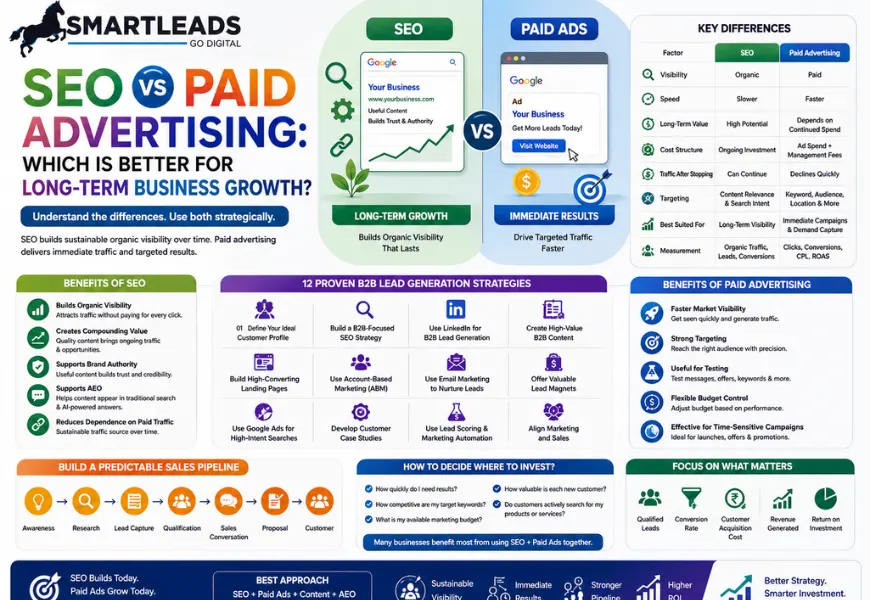
Businesses investing in digital marketing often face an important question: Should you invest in SEO or paid advertising?
The answer depends on your business goals, budget, competition, industry, and how quickly you need results. SEO can build sustainable organic visibility over time, while paid advertising can provide immediate exposure and targeted traffic. For many businesses, the strongest approach is not choosing one over the other, but using both strategically.
This guide explains the differences between SEO vs paid advertising, their benefits and limitations, and how businesses can decide where to invest.
What Is SEO?
Search Engine Optimization (SEO) is the process of improving a website and its content so it can appear more prominently in organic search results.
SEO typically includes:
- Keyword research
- Technical SEO
- On-page optimization
- Content creation
- Internal linking
- Local SEO
- Website performance improvements
- Authority and reputation building
For example, a digital marketing agency may create useful content targeting searches such as “digital marketing agency for small businesses” or “local SEO services.”
Unlike paid advertisements, businesses do not pay Google for every organic click. However, SEO requires ongoing investment in strategy, content, technical improvements, and optimization.
What Is Paid Advertising?
Paid advertising involves paying platforms such as Google or social media networks to display advertisements to targeted audiences.
Google Search Ads, for example, can place a business advertisement in front of users searching for specific products or services.
Paid advertising can provide:
- Faster visibility
- Immediate traffic
- Precise targeting
- Geographic targeting
- Budget control
- Measurable campaign data
- Flexible campaign testing
However, advertising costs continue as long as campaigns are running.
SEO vs Paid Advertising: Key Differences
| Factor | SEO | Paid Advertising |
| Visibility | Organic | Paid |
| Speed | Usually slower | Usually faster |
| Long-term value | High potential | Depends on continued spending |
| Cost structure | Ongoing investment | Ad spend + management costs |
| Traffic after stopping investment | Can continue | Usually declines quickly |
| Targeting | Primarily search intent and content relevance | Keyword, audience, location and other targeting options |
| Best suited for | Long-term visibility | Immediate campaigns and demand capture |
| Measurement | Organic traffic, leads, conversions | Clicks, conversions, CPL, ROAS |
Neither channel is automatically better. Their strengths are different.
Benefits of SEO for Long-Term Growth
1. Builds Organic Visibility
A well-optimized page can continue attracting relevant search traffic after it has been published.
2. Creates Compounding Value
High-quality content can attract traffic, backlinks, brand mentions, and additional opportunities over time.
3. Supports Brand Authority
Consistently publishing useful content can demonstrate expertise and build trust with potential customers.
4. Supports AEO
SEO and Answer Engine Optimization increasingly overlap around search intent, helpful content, clear answers, and structured information.
Creating content that directly answers customer questions can improve its usefulness across traditional search and AI-powered answer experiences.
5. Can Reduce Dependence on Paid Traffic
A strong organic presence can provide another source of qualified traffic rather than relying entirely on advertising.
Benefits of Paid Advertising
1. Faster Market Visibility
Paid campaigns can begin generating visibility soon after launch, subject to platform review and campaign conditions.
2. Strong Targeting
Businesses can target specific keywords, locations, audiences, devices, and other campaign parameters.
3. Useful for Testing
Paid campaigns can provide data about which messages, offers, keywords, and audiences generate conversions.
4. Flexible Budget Control
Businesses can set budgets and adjust campaigns based on performance.
5. Effective for Time-Sensitive Campaigns
Product launches, seasonal promotions, events, offers, and urgent lead-generation campaigns can benefit from paid advertising.
Which Is Better for Long-Term Business Growth?
For long-term business growth, SEO often provides stronger cumulative value, because organic visibility can continue generating traffic without paying for every individual click.
However, SEO is not a replacement for paid advertising.
A business launching a new service may use Google Ads to generate immediate demand while simultaneously building SEO content that can generate organic traffic in the future.
This creates a two-part strategy:
Paid advertising = capture demand now
SEO = build sustainable visibility for the future
When Should You Choose SEO?
SEO may be a stronger priority when:
- You want long-term organic traffic
- Customers regularly use search engines to find your services
- You have a longer growth horizon
- You want to build topical authority
- Your business operates in a competitive organic search market
- You can consistently invest in quality content and optimization
SEO is particularly valuable for businesses with evergreen products or services that people search for throughout the year.
When Should You Choose Paid Advertising?
Paid advertising may be the better immediate option when:
- You need leads quickly
- You are launching a new product
- You have a time-sensitive promotion
- You want to test market demand
- Your website has limited organic visibility
- You want highly targeted traffic
Paid advertising can also complement SEO by filling gaps where organic rankings are difficult to achieve.
Why Businesses Should Consider Using Both
SEO and paid advertising can reinforce each other.
For example, paid campaigns can identify high-converting search terms. Those insights can inform SEO content and landing-page strategy.
At the same time, strong organic content can help users who click an advertisement learn more about the company before making a purchase decision.
A balanced digital marketing strategy could look like:
SEO + AEO → Long-term organic visibility
Paid Advertising → Immediate targeted traffic
Content Marketing → Trust and education
Conversion Optimization → More leads and sales
Together, these channels can create a more resilient customer acquisition strategy.
How to Decide Where to Invest Your Budget
Ask five questions:
- How quickly do I need results?
- How competitive are my target keywords?
- What is my available marketing budget?
- How valuable is each new customer?
- Do customers actively search for my products or services?
If you need immediate leads, allocate part of your budget to paid campaigns. If your goal is sustainable organic growth, invest consistently in SEO.
For many businesses, a combination of both provides the best balance.
Final Thoughts
The SEO vs paid advertising debate does not need to end with choosing one channel.
SEO can help businesses build long-term visibility, authority, and sustainable organic traffic, while paid advertising can provide immediate reach, targeted traffic, and valuable campaign data.
For businesses focused on long-term growth, investing in SEO and AEO while using paid advertising strategically can create a balanced acquisition strategy.
The key is to measure more than clicks and rankings. Track qualified leads, conversions, customer acquisition cost, revenue, and ROI. When you understand how each channel contributes to the customer journey, you can allocate your marketing budget more intelligently and build a stronger foundation for sustainable growth.
FAQs
1. Is SEO better than paid advertising?
Neither is universally better. SEO is generally stronger for building long-term organic visibility, while paid advertising is useful for generating faster targeted traffic. The best option depends on business objectives and customer behaviour.
2. Is SEO cheaper than Google Ads?
SEO does not require paying Google for each organic click, but it still requires investment in content, technical optimization, expertise, and ongoing work. Google Ads requires continuous advertising spend when campaigns are active.
3. How long does SEO take to show results?
SEO timelines vary depending on competition, website authority, technical condition, content quality, and search demand. Some improvements may appear relatively quickly, while competitive keywords can take significantly longer.
4. Can SEO and paid advertising work together?
Yes. Combining SEO and paid advertising can provide immediate visibility while building long-term organic traffic. Data from paid campaigns can also help businesses understand which keywords and messages generate conversions.
5. Which should a small business choose first: SEO or paid advertising?
It depends on the business. If immediate leads are the priority, paid advertising may be useful. If the business wants to build sustainable search visibility, SEO may deserve greater emphasis. A carefully managed combination can often deliver the strongest overall strategy.