
Digital marketing can generate website traffic, brand awareness, leads, and sales, but how do you know whether your marketing investment is actually producing business results?
Digital marketing ROI (Return on Investment) measures how much value your business generates compared with what it spends on digital marketing. By tracking the right metrics, businesses can identify profitable channels, reduce wasted spending, improve campaigns, and make more informed marketing decisions.
Instead of focusing only on likes, impressions, or website visits, businesses should connect marketing activity with measurable outcomes such as qualified leads, conversions, customer acquisition, and revenue.
What Is Digital Marketing ROI?
Digital marketing ROI measures the financial return generated from digital marketing activities compared with the investment made.
A basic ROI formula is:
Digital Marketing ROI = (Revenue Generated − Marketing Cost) ÷ Marketing Cost × 100
For example, if a business spends ₹50,000 on a digital marketing campaign and generates ₹1,50,000 in attributable revenue:
ROI = (₹1,50,000 − ₹50,000) ÷ ₹50,000 × 100 = 200%
However, measuring ROI accurately requires more than looking at revenue alone. Businesses need to track the complete customer journey from first interaction to final conversion.
Why Is Measuring Digital Marketing ROI Important?
Without proper measurement, businesses may continue investing in campaigns simply because they generate traffic or engagement.
Measuring ROI helps you:
- Identify high-performing marketing channels
- Understand customer acquisition costs
- Improve advertising efficiency
- Allocate budgets more effectively
- Identify underperforming campaigns
- Measure lead quality
- Understand which content drives conversions
- Make data-driven marketing decisions
The most important question is not “How much traffic did we generate?” but “What business value did that traffic create?”
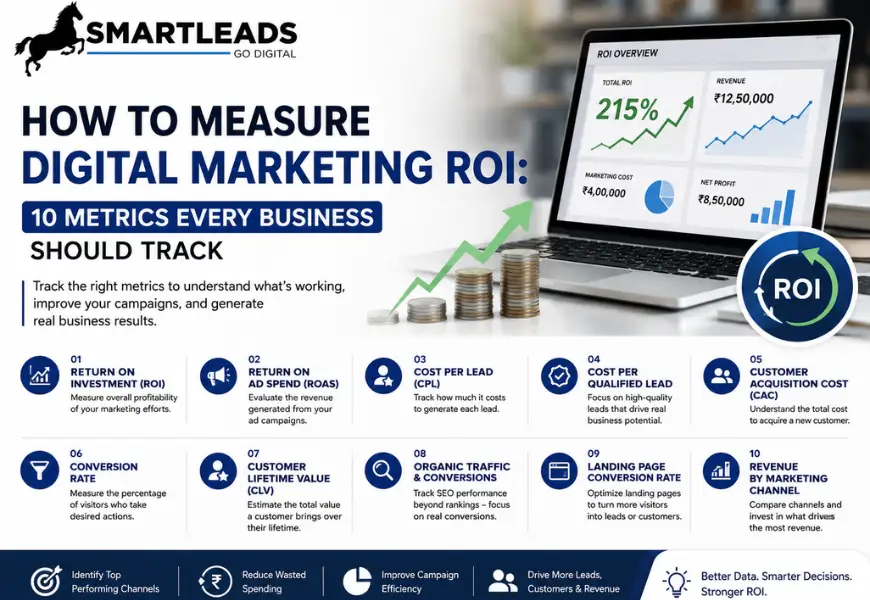
10 Digital Marketing Metrics Every Business Should Track
1. Return on Investment (ROI)
ROI is the most direct way to evaluate the financial performance of your marketing investment.
It helps answer whether the revenue generated justifies the amount spent on marketing.
However, attribution can be complex when customers interact with multiple channels before converting. Use ROI alongside other metrics rather than relying on one number.
2. Return on Ad Spend (ROAS)
ROAS is particularly useful for measuring paid advertising campaigns.
The formula is:
ROAS = Revenue Attributed to Ads ÷ Advertising Cost
For example, if you spend ₹20,000 on Google Ads and generate ₹80,000 in attributed revenue, your ROAS is 4:1.
ROAS helps businesses compare advertising campaigns and identify where paid media budgets may be working most efficiently.
3. Cost Per Lead (CPL)
Cost per lead shows how much your business spends to generate one lead.
CPL = Total Marketing Cost ÷ Number of Leads
If a campaign costs ₹30,000 and generates 100 leads, the CPL is ₹300.
However, a low CPL isn’t automatically good. If most of those leads are irrelevant, a campaign with a higher CPL but better lead quality may be more profitable.
4. Cost Per Qualified Lead
Cost per qualified lead goes one step further by measuring the cost of generating leads that meet your business’s qualification criteria.
This metric is particularly important for B2B and high-value services where not every enquiry has genuine purchase potential.
Tracking qualified leads helps marketing and sales teams focus on lead quality rather than lead volume.
5. Customer Acquisition Cost (CAC)
Customer acquisition cost measures how much it costs to acquire a new customer.
A simplified formula is:
CAC = Total Sales and Marketing Costs ÷ Number of New Customers
Compare CAC with customer revenue or customer lifetime value to determine whether your acquisition strategy is financially sustainable.
6. Conversion Rate
Conversion rate measures the percentage of visitors or prospects who complete a desired action.
Depending on your business, conversions could include:
- Contact form submissions
- Phone calls
- Purchases
- Consultation bookings
- Demo requests
- Newsletter sign-ups
Improving conversion rates can increase results without necessarily increasing traffic.
7. Customer Lifetime Value (CLV)
Customer lifetime value estimates the total value a customer can generate throughout their relationship with your business.
CLV is particularly important for subscription businesses, repeat-purchase businesses, and companies with long-term customer relationships.
When CLV is significantly higher than acquisition cost, your marketing model may have stronger long-term potential.
8. Organic Traffic and Organic Conversions
SEO performance should not be measured only by keyword rankings.
Track:
- Organic website traffic
- Organic leads
- Organic sales
- Conversion rate
- Revenue from organic search
This helps determine whether SEO is generating actual business outcomes rather than simply increasing visibility.
For AEO, also consider monitoring visibility and engagement from AI-powered search experiences where reliable measurement is available.
9. Landing Page Conversion Rate
Your marketing campaign may generate excellent traffic, but a weak landing page can prevent visitors from becoming leads or customers.
Track how many visitors complete the desired action after arriving on a campaign landing page.
Test elements such as:
- Headlines
- CTAs
- Forms
- Page structure
- Trust signals
- Offers
- Testimonials
Small improvements in conversion rate can have a significant impact on overall campaign ROI.
10. Revenue Generated by Marketing Channel
Finally, compare revenue across your major digital marketing channels.
For example:
| Channel | Leads | Customers | Revenue |
| SEO | 150 | 30 | ₹6,00,000 |
| Google Ads | 120 | 25 | ₹5,00,000 |
| Social Media | 80 | 10 | ₹1,50,000 |
| Email Marketing | 60 | 18 | ₹3,00,000 |
This type of analysis helps businesses understand which channels contribute most effectively to revenue.
How Can Businesses Improve Digital Marketing ROI?
Improving ROI isn’t always about spending less. It is about spending more effectively.
Start by identifying your best-performing channels. Improve targeting, strengthen landing pages, create content based on search intent, remove ineffective campaigns, and regularly test new approaches.
Also connect marketing and sales data. A campaign may appear successful because it generates many leads, but the sales team may discover that those leads rarely become customers.
The strongest ROI measurement system connects marketing → leads → qualified opportunities → customers → revenue.
Final Thoughts
Measuring digital marketing ROI is essential for turning marketing activity into measurable business growth. Traffic, clicks, impressions, and engagement can provide useful context, but they should ultimately connect to leads, customers, revenue, and profitability.
Start by tracking the 10 metrics that matter most to your business, establish clear conversion goals, connect marketing data with sales results, and regularly compare performance across channels.
The goal isn’t simply to spend more on digital marketing. It is to understand where your investment creates the greatest business value—and continuously optimize your strategy around those insights.
FAQs
1. What is a good digital marketing ROI?
There is no universal ROI benchmark because profitability depends on the industry, business model, margins, customer lifetime value, and acquisition costs. Compare your ROI with historical performance and business objectives.
2. What is the difference between ROI and ROAS?
ROI measures the overall return relative to an investment, while ROAS specifically measures revenue generated from advertising spend. ROAS is commonly used for paid media campaigns.
3. Which digital marketing metric is most important?
There is no single metric for every business. Revenue, ROI, customer acquisition cost, qualified leads, conversion rate, and customer lifetime value are often more meaningful than surface-level engagement metrics.
4. How can I calculate digital marketing ROI?
Subtract your digital marketing costs from the revenue attributable to marketing, divide the result by marketing cost, and multiply by 100. Accurate attribution is important when customers interact with multiple marketing channels.
5. How often should businesses measure digital marketing ROI?
Review key performance metrics regularly—often weekly or monthly depending on campaign volume—and conduct deeper ROI analysis monthly or quarterly. Avoid making major decisions from very small data samples.