
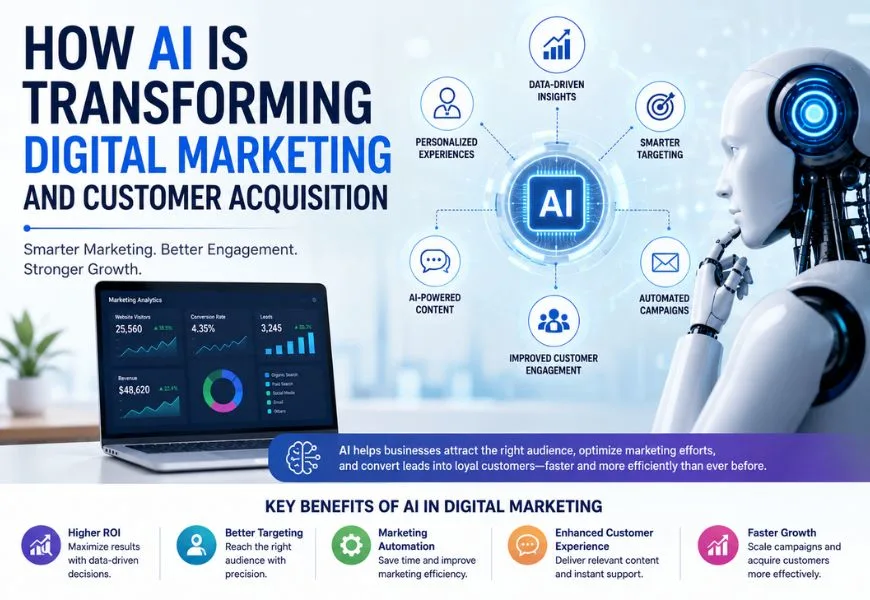
Artificial Intelligence (AI) is no longer a futuristic concept—it’s a powerful business tool that is reshaping the way companies market their products, engage customers, and generate leads. From personalized recommendations and predictive analytics to AI-powered content creation and customer support, AI has become an essential component of modern digital marketing.
As businesses compete for attention in increasingly crowded online spaces, leveraging AI in digital marketing has become critical for improving efficiency, enhancing customer experiences, and driving growth. In 2026, companies that successfully integrate AI into their marketing strategies are gaining a significant advantage over competitors who rely solely on traditional methods.
This article explores how AI is transforming digital marketing and customer acquisition, along with the key benefits, applications, and future trends businesses should know.
What Is AI in Digital Marketing?
AI in digital marketing refers to the use of artificial intelligence technologies to automate, analyze, and optimize marketing activities. AI systems can process vast amounts of data, identify patterns, predict customer behavior, and make intelligent decisions in real time.
AI-powered marketing tools help businesses:
- Understand customer preferences
- Deliver personalized experiences
- Automate repetitive tasks
- Improve campaign performance
- Generate higher-quality leads
- Increase conversion rates
By combining machine learning, natural language processing, and predictive analytics, AI enables marketers to make smarter and faster decisions.
Why AI Matters in Digital Marketing
Today’s consumers expect personalized experiences and instant responses. Traditional marketing approaches often struggle to meet these expectations at scale.
AI helps businesses:
- Analyze large datasets quickly
- Improve targeting accuracy
- Optimize advertising spend
- Enhance customer engagement
- Increase marketing ROI
As search engines, social media platforms, and advertising networks continue integrating AI into their systems, businesses must adapt to remain competitive.
1. AI-Powered Customer Insights
One of AI’s biggest strengths is its ability to analyze customer behavior.
AI tools can examine:
- Website interactions
- Purchase history
- Search behavior
- Social media engagement
- Email responses
This data helps marketers understand what customers want and when they are most likely to take action.
Benefits
- Better audience segmentation
- More accurate targeting
- Improved campaign performance
- Enhanced customer experiences
Businesses can make data-driven decisions rather than relying on assumptions.
2. Personalized Marketing at Scale
Personalization has become a major factor in customer acquisition and retention.
AI enables businesses to deliver:
- Personalized product recommendations
- Customized email campaigns
- Dynamic website content
- Targeted advertisements
For example, AI can recommend products based on previous purchases or browsing behavior, increasing the likelihood of conversions.
Consumers are more likely to engage with brands that provide relevant and personalized experiences.
3. AI-Powered Content Creation
Content marketing remains one of the most effective ways to attract customers.
AI tools now assist with:
- Blog topic generation
- Content outlines
- Social media captions
- Email copy
- SEO optimization
While human creativity and expertise remain essential, AI helps marketers produce content more efficiently and consistently.
Advantages
- Faster content production
- Improved content planning
- Better keyword targeting
- Enhanced productivity
This allows marketing teams to focus on strategy and creativity rather than repetitive tasks.
4. Smarter Search Engine Optimization (SEO)
AI is transforming how businesses approach SEO.
Search engines increasingly use AI to understand:
- User intent
- Content relevance
- Search context
- Conversational queries
Modern SEO strategies now focus on:
- Answer Engine Optimization (AEO)
- Topic authority
- User experience
- Structured data
- Natural language content
Businesses that optimize for AI-powered search experiences have a greater chance of appearing in featured snippets and AI-generated search results.
5. Improved Paid Advertising Performance
AI has revolutionized digital advertising platforms such as Google Ads and social media advertising.
AI helps optimize:
- Audience targeting
- Bid strategies
- Ad placements
- Budget allocation
- Campaign performance
Machine learning algorithms continuously analyze performance data and automatically adjust campaigns for better results.
Key Benefits
- Lower cost per acquisition
- Higher conversion rates
- Better ad relevance
- Increased return on investment
This makes advertising more efficient and effective.
6. AI Chatbots and Conversational Marketing
Customers expect immediate responses when interacting with businesses online.
AI-powered chatbots provide:
- 24/7 customer support
- Instant answers to common questions
- Lead qualification
- Appointment scheduling
- Product recommendations
Chatbots improve customer experiences while reducing the workload on support teams.
They also help businesses capture and nurture leads outside normal business hours.
7. Predictive Analytics for Customer Acquisition
Predictive analytics uses AI to forecast future customer behavior.
AI can predict:
- Purchase likelihood
- Customer lifetime value
- Churn risk
- Preferred communication channels
Businesses can use these insights to target prospects more effectively and prioritize high-value opportunities.
Predictive analytics helps marketers allocate resources more efficiently and maximize results.
8. Marketing Automation and Workflow Efficiency
AI-powered automation tools streamline marketing operations.
Tasks that can be automated include:
- Email campaigns
- Lead nurturing
- Social media scheduling
- Customer segmentation
- Reporting and analytics
Automation reduces manual effort while improving consistency and scalability.
This allows teams to focus on strategic growth initiatives rather than routine administrative tasks.
Challenges of Using AI in Digital Marketing
Although AI offers significant benefits, businesses should be aware of potential challenges:
- Data privacy concerns
- Dependence on accurate data
- Need for human oversight
- Learning curve for implementation
- Maintaining authentic brand communication
Successful AI adoption requires balancing automation with human expertise.
The Future of AI in Digital Marketing
AI will continue transforming digital marketing in the coming years.
Emerging trends include:
- Hyper-personalized customer experiences
- AI-generated search results
- Voice search optimization
- Predictive customer journeys
- Advanced marketing automation
- Real-time campaign optimization
Businesses that embrace these innovations will be better positioned to attract, engage, and retain customers.
Final Thoughts
The rise of AI in digital marketing is transforming how businesses attract customers, optimize campaigns, and drive growth. From personalized marketing and predictive analytics to AI-powered SEO and automation, artificial intelligence is helping companies work smarter and achieve better results.
However, the most successful businesses will not rely solely on AI. Instead, they will combine advanced technology with human creativity, expertise, and strategic thinking. By embracing AI-driven marketing while maintaining a customer-focused approach, businesses can improve customer acquisition, increase efficiency, and stay ahead in an increasingly competitive digital landscape.
As AI continues to evolve, organizations that adapt early will be best positioned to capitalize on new opportunities and achieve sustainable growth in 2026 and beyond.
FAQs
- What is AI in digital marketing?
AI in digital marketing refers to the use of artificial intelligence technologies to automate, analyze, and optimize marketing activities such as content creation, advertising, customer engagement, and lead generation.
- How does AI improve customer acquisition?
AI improves customer acquisition by analyzing customer behavior, personalizing marketing campaigns, optimizing advertising performance, and identifying high-converting prospects.
- Can AI replace digital marketers?
No. AI enhances marketing efficiency and decision-making, but human creativity, strategy, and relationship-building remain essential for successful marketing.
- How does AI affect SEO?
AI helps search engines better understand user intent and content quality. Businesses must focus on Answer Engine Optimization (AEO), user experience, and high-quality content to remain competitive.
- What are the best AI tools for digital marketing?
Popular AI tools include ChatGPT, Google Gemini, HubSpot AI, Jasper, Surfer SEO, Semrush AI features, and various marketing automation platforms.