
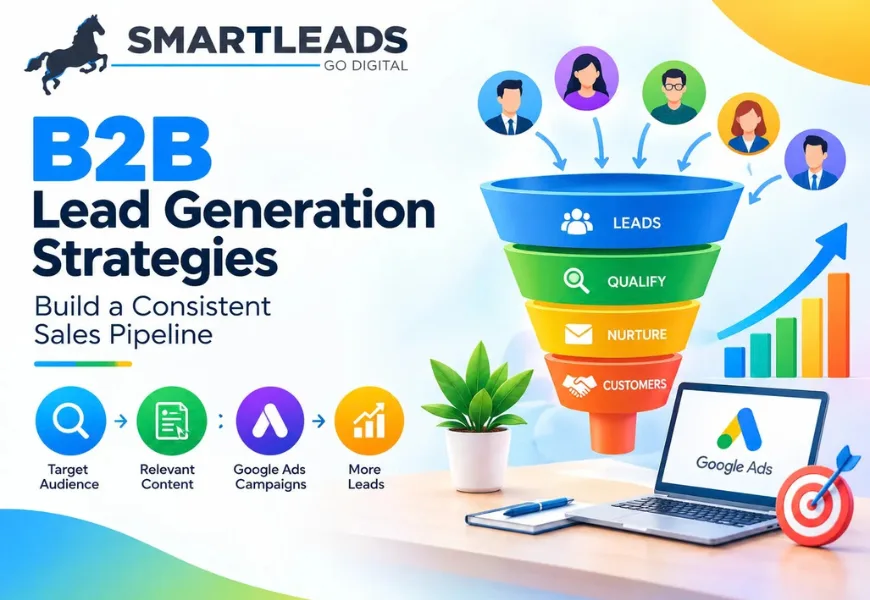
For B2B companies, generating leads consistently is one of the biggest challenges in digital marketing. A business may have a strong product or service, but without a predictable way to attract and nurture potential buyers, sales growth can become difficult to sustain.
B2B lead generation is the process of identifying, attracting and converting businesses or decision-makers who may be interested in your products or services.
A successful B2B lead generation strategy is not about collecting as many contacts as possible. It is about finding qualified prospects, building relationships and moving the right leads toward a sales conversation.
What Is B2B Lead Generation?
B2B lead generation is the process of attracting potential business customers and collecting their information so they can be qualified, nurtured and converted into customers.
Depending on the business model, a B2B lead could be:
- A company requesting a proposal
- A decision-maker submitting an enquiry
- A business booking a consultation
- A prospect requesting a product demo
- A company downloading a valuable resource
- A potential customer responding to an outreach campaign
The best strategy depends on the target audience, sales cycle, industry and value of the product or service.
Why Is B2B Lead Generation Important?
B2B purchases often involve multiple decision-makers and longer sales cycles than many B2C purchases.
Businesses therefore need a consistent system for attracting prospects rather than relying entirely on referrals or occasional enquiries.
A strong B2B lead generation strategy can help companies:
- Build a predictable sales pipeline
- Reach decision-makers
- Increase qualified enquiries
- Reduce dependence on referrals
- Improve sales and marketing alignment
- Nurture prospects over time
- Measure marketing performance
The objective is to create a repeatable process from first interaction to qualified sales opportunity.
1. Define Your Ideal Customer Profile
Before generating leads, understand exactly who you want to reach.
Create an Ideal Customer Profile (ICP) based on factors such as:
- Industry
- Company size
- Location
- Revenue
- Business needs
- Technology used
- Decision-maker role
- Purchasing requirements
For example, a B2B marketing agency might target small and medium-sized companies that already have a website but need more qualified leads.
A clear ICP helps prevent marketing budgets from being wasted on audiences that are unlikely to become customers.
2. Use SEO to Attract High-Intent Prospects
Search engine optimization can become a powerful long-term B2B lead generation channel.
Create content around questions and problems your potential customers are actively searching for.
Examples include:
How to generate B2B leads online
Best B2B lead generation strategies
SEO for B2B companies
How to reduce customer acquisition costs
B2B digital marketing strategy
Focus on providing useful answers rather than simply repeating keywords.
This can attract prospects earlier in the buying journey and introduce them to your brand before they contact competitors.
3. Create High-Value Lead Magnets
Not every prospect is ready to request a sales call immediately.
Offer useful resources in exchange for contact information.
Examples include:
- Industry reports
- Checklists
- Templates
- Guides
- Case studies
- Webinars
- Research reports
- ROI calculators
The resource should solve a genuine problem for your target audience.
4. Use LinkedIn for B2B Prospecting
LinkedIn can be particularly useful for B2B businesses because professionals and decision-makers actively use the platform.
Businesses can use LinkedIn to:
- Publish educational content
- Build professional authority
- Connect with relevant decision-makers
- Share case studies
- Start conversations
- Promote valuable resources
Avoid turning every interaction into an immediate sales pitch. Building familiarity and trust can make future sales conversations more effective.
5. Combine Paid Advertising With Organic Marketing
Paid advertising can accelerate B2B lead generation when targeting and conversion tracking are properly configured.
Businesses can use platforms such as Google Ads and LinkedIn Ads to reach specific audiences.
Google Ads can capture existing search demand, while social advertising can help businesses reach potential prospects based on professional or audience characteristics.
Combining paid and organic channels can create a more balanced acquisition strategy.
6. Build Conversion-Focused Landing Pages
Getting visitors to your website is only the first step.
Your landing page should clearly explain:
What you offer → Who it is for → Why it matters → What the visitor should do next
Use clear headlines, relevant benefits, trust signals, case studies and a simple call to action.
Avoid overwhelming visitors with too many competing actions.
A focused landing page can make it easier for qualified prospects to take the next step.
7. Nurture Leads With Email Marketing
Not every B2B lead will be ready to buy immediately.
Email nurturing allows businesses to stay connected with prospects while they evaluate their options.
Useful content can include:
- Educational articles
- Industry insights
- Case studies
- Product information
- Customer success stories
- Webinars
- Relevant offers
The objective is to remain useful rather than sending repetitive promotional messages.
8. Use Marketing Automation
As lead volume increases, manually managing every prospect becomes difficult.
Marketing automation can help businesses:
- Capture leads
- Segment prospects
- Send follow-up emails
- Score leads
- Notify sales teams
- Track interactions
- Identify high-intent prospects
Automation should support the sales process rather than replace strategic human interaction.
9. Measure Lead Quality, Not Just Lead Volume
A campaign generating 500 low-quality leads may be less valuable than one generating 50 highly qualified prospects.
Track metrics such as:
- Cost per lead
- Qualified lead rate
- Conversion rate
- Cost per qualified lead
- Sales opportunities
- Customer acquisition cost
- Lead-to-customer rate
- Revenue generated
These metrics help businesses understand which channels actually contribute to growth.
B2B Lead Generation and AEO
B2B companies should also consider Answer Engine Optimization (AEO).
Decision-makers increasingly use AI-powered search tools to research suppliers, technologies, agencies and solutions.
Create content that directly answers questions such as:
What is the best B2B lead generation strategy?
How can B2B companies generate qualified leads?
How much does B2B lead generation cost?
Clear, authoritative answers can improve your brand’s visibility across modern search experiences.
Final Thoughts
B2B lead generation works best when it is treated as a complete system rather than a single marketing campaign.
Start by defining your ideal customer. Then combine SEO, content marketing, LinkedIn, paid advertising, landing pages, email nurturing and marketing automation to attract and develop potential customers.
Most importantly, focus on lead quality and business outcomes, not simply the number of contacts generated.
A consistent B2B lead generation strategy can help businesses build a healthier sales pipeline, improve marketing efficiency and create more predictable opportunities for long-term growth.
Smart Leads Digital can help businesses build an integrated B2B lead generation strategy using SEO, AEO, Google Ads, social media marketing, content marketing, conversion optimization and marketing automation to turn digital visibility into qualified business opportunities.
FAQs
1. What is B2B lead generation?
B2B lead generation is the process of attracting and identifying potential business customers and moving qualified prospects toward a sales conversation or purchase.
2. What is the best B2B lead generation strategy?
There is no single strategy that works for every business. SEO, content marketing, LinkedIn, paid advertising, email marketing, outbound prospecting and marketing automation can work together depending on the target audience and sales cycle.
3. How can businesses generate better-quality B2B leads?
Define a clear Ideal Customer Profile, target high-intent audiences, create relevant content, use focused landing pages and measure qualified leads rather than total lead volume.
4. How long does B2B lead generation take?
The timeline varies by industry, product value, sales cycle, audience and marketing channel. Paid campaigns can generate enquiries quickly, while SEO, content marketing and authority-building generally require consistent effort over a longer period.
5. How can B2B companies measure lead generation success?
Track metrics such as qualified leads, conversion rates, cost per qualified lead, sales opportunities, customer acquisition cost and revenue. These provide a better picture of performance than website traffic alone.