
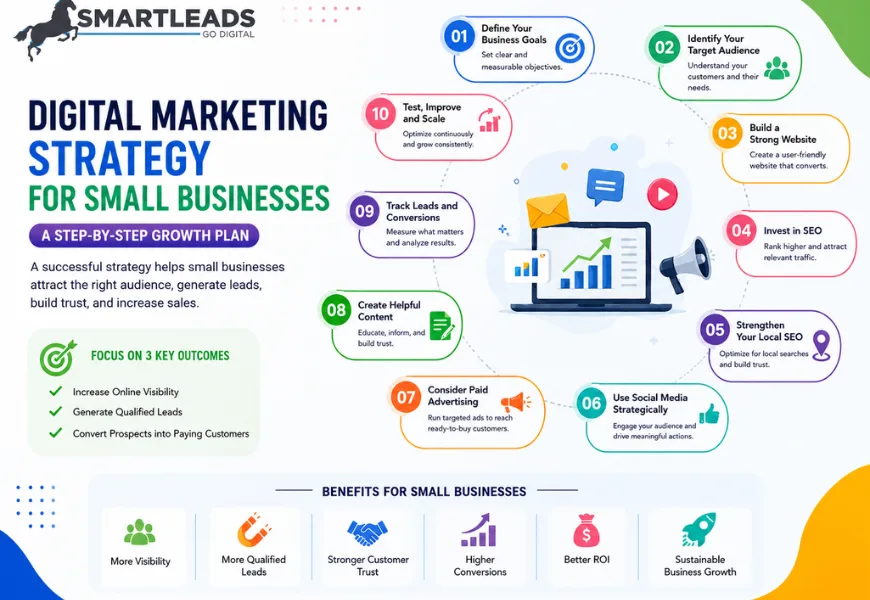
Small businesses often know they need digital marketing, but the real challenge is knowing where to start, what channels to use, and how to turn online visibility into measurable business growth. A well-planned digital marketing strategy can help small businesses attract the right audience, generate leads, build trust, and increase sales without wasting money on channels that do not deliver results.
A successful strategy does not require being active everywhere. It requires choosing the right platforms, understanding your customers, creating useful content, and consistently measuring performance.
What Is a Digital Marketing Strategy for Small Businesses?
A digital marketing strategy is a structured plan for using online channels such as SEO, social media, Google Ads, content marketing, email marketing, and websites to reach business goals.
For small businesses, the strategy should focus on three key outcomes:
- Increasing online visibility
- Generating qualified leads
- Converting prospects into paying customers
The right approach depends on the business type, target audience, location, budget, competition, and growth objectives.
Step 1: Define Your Business Goals
Before investing in digital marketing, determine what you want to achieve.
Your goals could include:
- Getting more website visitors
- Generating phone calls or enquiries
- Increasing online sales
- Improving local visibility
- Building brand awareness
- Generating B2B leads
- Increasing customer retention
Make your goals specific and measurable. Instead of saying “I want more customers,” set a target such as “Generate 50 qualified enquiries per month.”
Step 2: Identify Your Target Audience
Effective digital marketing starts with understanding your ideal customer.
Consider:
- Who are they?
- What problems are they trying to solve?
- What products or services do they need?
- Where do they search for information?
- What factors influence their buying decision?
Creating customer personas can help you develop content and campaigns that speak directly to your audience.
Step 3: Build a Strong Website
Your website is often the central point of your digital marketing strategy. It should clearly explain what you offer, who you serve, why customers should choose you, and how they can contact you.
A small-business website should have:
- Clear service or product pages
- Mobile-friendly design
- Fast loading speed
- Simple navigation
- Strong calls to action
- Contact forms and business information
- Trust signals such as reviews, testimonials, certifications, or case studies
A beautiful website is not enough. It also needs to support SEO and conversions.
Step 4: Invest in SEO
Search engine optimization helps your business appear when potential customers search for relevant products or services.
Start with keyword research based on your customers’ actual search behaviour. Target a combination of:
- Local keywords
- Service-based keywords
- Problem-based searches
- Long-tail keywords
- Question-based queries
For example, a local service business could target searches such as “digital marketing agency near me,” “SEO services for small businesses,” or “best digital marketing agency in Chennai.”
For stronger AEO visibility, create content that directly answers questions customers ask. Clear definitions, step-by-step explanations, comparison articles, FAQs, and concise answers can help your content become more useful for search engines and AI-powered answer platforms.
Step 5: Strengthen Your Local SEO
If your business serves a specific city or geographic area, local SEO can be one of the most valuable digital marketing investments.
Optimize your:
- Google Business Profile
- Business name, address, and phone information
- Local landing pages
- Customer reviews
- Location-based keywords
- Local business citations
Consistently collecting genuine customer reviews can also strengthen trust and influence purchasing decisions.
Step 6: Use Social Media Strategically
Small businesses do not need to be present on every social platform.
Choose the platforms where your target customers are most active. Depending on your business, this could include Instagram, Facebook, LinkedIn, YouTube, or other relevant channels.
Create content around:
- Educational tips
- Product demonstrations
- Customer success stories
- Behind-the-scenes content
- Frequently asked questions
- Industry insights
- Offers and promotions
The goal should not simply be to collect followers. Social media should support brand awareness, engagement, website traffic, enquiries, and sales.
Step 7: Consider Paid Advertising
SEO can generate sustainable organic traffic, but paid advertising can help businesses reach potential customers more quickly.
Google Ads can target people actively searching for specific products and services, while social advertising can help businesses reach audiences based on demographics, interests, behaviours, and other targeting signals.
Start with a controlled budget, track conversions, and optimize campaigns based on actual results rather than clicks alone.
Step 8: Create Helpful Content
Content marketing helps small businesses demonstrate expertise and answer customer questions before a sales conversation happens.
Useful formats include:
- Blog articles
- FAQs
- Guides
- Case studies
- Videos
- Social media posts
- Checklists
- Comparison articles
For AEO, focus on questions with clear user intent, such as “How much does digital marketing cost?”, “Which is better, SEO or Google Ads?”, and “How can a small business generate leads online?”
Step 9: Track Leads and Conversions
Traffic and impressions are useful, but they do not necessarily mean business growth.
Track metrics such as:
- Website leads
- Qualified enquiries
- Conversion rate
- Cost per lead
- Customer acquisition cost
- Organic traffic
- Keyword visibility
- Google Ads conversions
- Social media enquiries
- Return on advertising spend
This data helps you understand which channels are actually contributing to revenue.
Step 10: Test, Improve and Scale
Digital marketing is not a one-time activity. Review your results regularly and identify what is working.
If SEO generates high-quality leads, increase your investment in content and optimization. If a paid campaign has a high cost per acquisition, test different audiences, landing pages, advertisements, or keywords.
The best strategy evolves with your customers, competitors, technology, and business goals.
Final Thoughts
A successful digital marketing strategy for small businesses is not about spending more money or using every available platform. It is about reaching the right audience with the right message through the right channels.
Start with clear goals, understand your customers, build a strong website, invest in SEO and local visibility, create helpful content, use paid advertising strategically, and measure the leads and revenue generated from each channel.
Most importantly, treat digital marketing as an ongoing growth process. Test, measure, learn, and improve. With the right strategy and consistent execution, even a small business can build a stronger online presence, attract qualified customers, and create sustainable long-term growth.
FAQs
1. What is the best digital marketing strategy for a small business?
There is no single strategy that works for every business. A combination of SEO, local SEO, content marketing, social media, and paid advertising can be effective when selected according to the target audience and business objectives.
2. How much should a small business spend on digital marketing?
The appropriate budget depends on the industry, competition, location, goals, and available resources. Start with a manageable budget, measure results, and increase investment in channels that consistently generate qualified leads.
3. Is SEO better than Google Ads for small businesses?
SEO and Google Ads serve different purposes. SEO can build long-term organic visibility, while Google Ads can generate targeted traffic quickly. Many businesses benefit from using both as part of a broader strategy.
4. How long does digital marketing take to produce results?
Paid advertising can generate results relatively quickly, while SEO and content marketing generally require more time to build visibility and authority. Results vary based on competition, website quality, strategy, and consistency.
5. How can small businesses generate more leads online?
Small businesses can generate leads through SEO, Google Ads, social media marketing, valuable content, local SEO, optimized landing pages, email marketing, and strong calls to action. Tracking conversions is essential to identify which channels produce the best leads.