
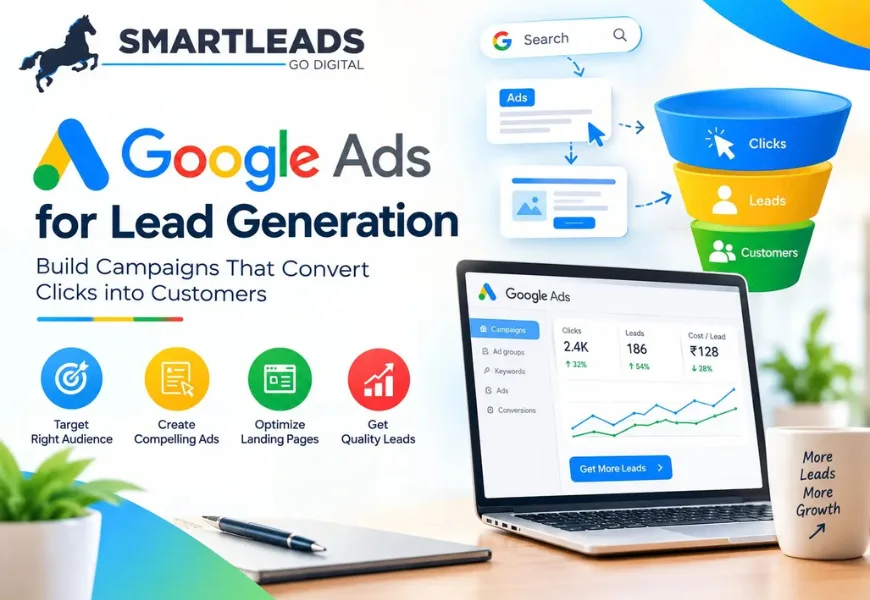
Google Ads can help businesses reach potential customers at the exact moment they are searching for a product or service. But generating clicks is not the same as generating customers.
A successful Google Ads lead generation strategy focuses on attracting the right searchers, sending them to relevant landing pages and making it easy for them to enquire, call or submit their details.
For businesses and digital marketing agencies, the goal should be simple: turn advertising spend into qualified leads and measurable business opportunities.
What Is Google Ads Lead Generation?
Google Ads lead generation is the process of using paid Google advertising campaigns to attract potential customers and convert them into leads.
Depending on the business, a lead could be:
- A completed enquiry form
- A phone call
- A WhatsApp enquiry
- A consultation request
- A product demonstration
- A quote request
- A booking
Google Ads can be particularly useful for businesses targeting high-intent searches.
For example, someone searching “B2B lead generation agency” or “digital marketing agency near me” may already be considering a service provider.
Why Use Google Ads for Lead Generation?
One of the biggest advantages of Google Ads is its ability to reach users based on their search intent.
Organic SEO can take time to build visibility. Paid search campaigns can provide visibility much faster when campaigns are properly structured.
Google Ads can help businesses:
- Reach high-intent prospects
- Target specific locations
- Control advertising budgets
- Test different offers
- Generate measurable enquiries
- Track conversions
- Scale campaigns based on performance
However, simply increasing the advertising budget does not guarantee better results. Campaign strategy and conversion quality matter more than clicks alone.
How to Build a Google Ads Campaign That Converts
1. Define Your Ideal Customer
Before creating a campaign, identify who you want to attract.
Consider:
- Location
- Industry
- Business size
- Customer needs
- Search intent
- Budget
- Buying stage
For example, a B2B digital marketing campaign may target business owners and marketing managers rather than a broad audience looking for general marketing information.
The more clearly you define your audience, the easier it becomes to create relevant campaigns.
2. Choose High-Intent Keywords
Keyword selection is one of the most important parts of Google Ads lead generation.
Focus on keywords that indicate commercial intent.
Examples include:
SEO services
digital marketing agency
Google Ads agency
B2B lead generation services
local SEO services
digital marketing company near me
Informational keywords can generate traffic but may not always produce leads.
Use keyword research and search-term data to identify which queries are actually bringing relevant prospects.
3. Group Keywords Into Relevant Ad Groups
Avoid putting every keyword into one campaign or ad group.
Create closely related groups based on user intent.
For example:
Campaign: Digital Marketing Services
- SEO services
- Local SEO services
- Google Ads services
- Social media marketing
This allows ad copy and landing pages to be more closely aligned with the user’s search.
4. Write Ads That Match Search Intent
Your advertisement should quickly communicate why someone should choose your business.
A strong ad can include:
- Relevant service
- Main customer benefit
- Location
- Unique value proposition
- Clear call to action
For example:
Generate More Qualified Leads With Digital Marketing
SEO, Google Ads & AEO Strategies Designed for Business Growth.
Get a Consultation
The message should match the keyword and the page users land on.
5. Create Dedicated Landing Pages
Sending every Google Ads visitor to your homepage may reduce conversion opportunities.
Create landing pages specifically designed for each major service or campaign.
A strong landing page should include:
- Clear headline
- Relevant service information
- Key benefits
- Trust signals
- Testimonials or case studies where appropriate
- Simple enquiry form
- Strong CTA
- Contact information
The landing page should answer the visitor’s question and make the next step obvious.
6. Track the Right Conversions
Clicks and impressions are useful, but they don’t tell you whether your advertising is generating business.
Track actions such as:
Form submissions → Phone calls → Consultation requests → Qualified leads → Sales
This helps businesses understand which campaigns and keywords are actually contributing to revenue.
7. Use Negative Keywords
Not every search containing your target keyword is valuable.
Negative keywords can help prevent ads from appearing for irrelevant searches.
For example, depending on your business, you may want to exclude searches related to:
- Free services
- Jobs
- Courses
- Tutorials
- Templates
This can help reduce wasted advertising spend and improve traffic quality.
8. Optimize Campaigns Regularly
Google Ads should not be treated as a “set it and forget it” marketing channel.
Review performance regularly and analyze:
- Cost per lead
- Conversion rate
- Search terms
- Click-through rate
- Lead quality
- Cost per conversion
- Campaign performance
- Landing-page performance
Then adjust keywords, ads, targeting and budgets based on actual results.
Google Ads vs SEO for Lead Generation
Both Google Ads and SEO can generate leads, but they work differently.
Google Ads can provide immediate paid visibility when campaigns are active, while SEO focuses on building long-term organic visibility.
For many businesses, combining both can create a stronger acquisition strategy:
Google Ads → Immediate visibility
SEO → Long-term organic traffic
AEO → Visibility across answer-focused and AI search experiences
Together, these channels can support a broader digital marketing strategy.
Final Thoughts
Google Ads lead generation is about much more than buying clicks. The strongest campaigns connect the right search query with the right advertisement, landing page and conversion experience.
Start with clear customer targeting and high-intent keywords. Then build relevant ad groups, compelling advertisements and dedicated landing pages. Most importantly, track qualified leads and business outcomes, not just traffic.
When Google Ads is combined with SEO, AEO, conversion rate optimization and strong follow-up processes, businesses can create a more complete digital lead-generation system.
Smart Leads Digital can help businesses build and optimize Google Ads lead generation campaigns with a focus on targeting, conversion tracking, landing-page optimization and measurable business growth.
FAQs
1. What is Google Ads lead generation?
Google Ads lead generation uses paid advertisements on Google to attract potential customers and encourage them to complete actions such as forms, calls, bookings or consultation requests.
2. How much does Google Ads lead generation cost?
There is no single fixed cost. Advertising costs vary based on industry, competition, keywords, location, targeting and campaign performance. Businesses should determine budgets based on lead value and desired acquisition costs.
3. How can I get better-quality leads from Google Ads?
Focus on high-intent keywords, precise targeting, relevant advertisements, dedicated landing pages, negative keywords and accurate conversion tracking. Review actual lead quality rather than optimizing only for clicks.
4. What is a good conversion rate for Google Ads?
There is no universal conversion rate that applies to every business. Performance depends on industry, offer, keyword intent, landing page, competition and audience. Businesses should establish benchmarks based on their own historical performance and lead quality.
5. Is Google Ads better than SEO for lead generation?
Neither is universally better. Google Ads can provide paid visibility quickly, while SEO can build sustainable organic visibility over time. Many businesses benefit from using both strategies together.