
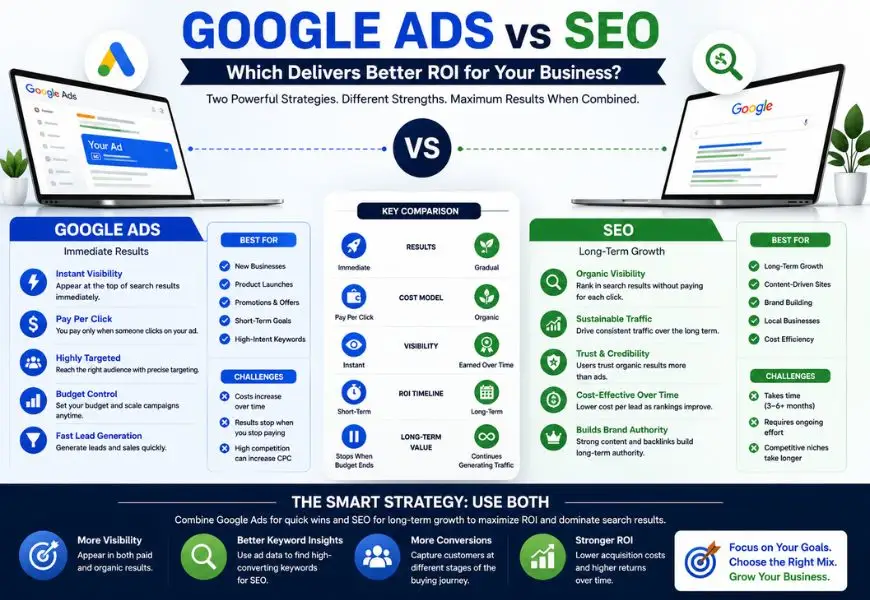
When businesses want to increase website traffic, generate leads, and boost sales, two of the most effective digital marketing channels often come into focus: Google Ads and SEO (Search Engine Optimization). Both strategies can drive valuable traffic and conversions, but many business owners ask the same question:
“Google Ads vs SEO: Which delivers better ROI for my business?”
The answer depends on your goals, budget, competition, and timeline. While Google Ads can provide immediate visibility, SEO offers sustainable long-term growth. Understanding the strengths and limitations of each approach can help you make smarter marketing decisions.
In this guide, we’ll compare Google Ads and SEO, examine their ROI potential, and help you determine which strategy is best for your business in 2026.
What Is Google Ads?
Google Ads is Google’s pay-per-click (PPC) advertising platform that allows businesses to display ads at the top of search engine results pages (SERPs).
With Google Ads, businesses bid on keywords related to their products or services. Every time a user clicks on an ad, the advertiser pays a fee.
Benefits of Google Ads
- Immediate visibility
- Fast lead generation
- Precise audience targeting
- Budget flexibility
- Detailed performance tracking
- Ideal for promotions and seasonal campaigns
Google Ads is often the fastest way to reach customers actively searching for solutions.
What Is SEO?
Search Engine Optimization (SEO) is the process of improving a website’s visibility in organic search results.
SEO involves optimizing:
- Website content
- Keywords
- Technical performance
- User experience
- Backlinks
- Local search signals
Unlike Google Ads, SEO traffic is not paid for directly. Instead, businesses earn rankings through relevance, authority, and content quality.
Benefits of SEO
- Long-term traffic growth
- Higher trust and credibility
- Lower cost per lead over time
- Sustainable results
- Increased brand authority
- Better user experience
SEO is often viewed as a long-term investment in digital visibility.
Google Ads vs SEO: Key Differences
| Factor | Google Ads | SEO |
| Traffic Speed | Immediate | Gradual |
| Cost Model | Pay Per Click | Organic |
| Visibility | Instant | Earned Over Time |
| Long-Term Value | Stops When Budget Ends | Continues Generating Traffic |
| Trust Factor | Moderate | High |
| Lead Generation | Fast | Consistent Long-Term |
| ROI Timeline | Short-Term | Long-Term |
| Competition Impact | Bid-Based | Authority-Based |
Both channels serve different purposes and can complement each other effectively.
When Google Ads Delivers Better ROI
Google Ads often produces better ROI when businesses need quick results.
Ideal Situations for Google Ads
New Businesses
A newly launched website may take months to rank organically. Google Ads provides immediate exposure.
Product Launches
Ads can drive traffic and awareness during product introductions.
Time-Sensitive Campaigns
Seasonal promotions, events, and limited-time offers benefit from immediate visibility.
High-Intent Keywords
Users searching for terms such as:
- “Buy CRM software”
- “Digital marketing agency near me”
- “Emergency plumbing service”
are often ready to convert.
In these situations, Google Ads can generate leads and sales quickly.
When SEO Delivers Better ROI
SEO often provides stronger ROI over the long term because traffic continues even after initial optimization efforts.
Ideal Situations for SEO
Long-Term Growth Goals
Businesses seeking sustainable traffic benefit greatly from SEO.
Content-Driven Industries
Healthcare, education, finance, legal services, and technology companies often achieve excellent results through content marketing and SEO.
Budget-Conscious Businesses
While SEO requires investment, long-term organic traffic can reduce dependence on paid advertising.
Building Brand Authority
High-ranking websites often gain more trust from users than paid advertisements.
Over time, SEO can generate leads at a lower cost compared to ongoing ad spend.
ROI Comparison: Google Ads vs SEO
Google Ads ROI
Advantages:
- Immediate traffic
- Predictable scaling
- Quick testing opportunities
Challenges:
- Rising cost-per-click (CPC)
- Ongoing budget requirements
- Traffic stops when ads stop
Example:
A business spending ₹50,000 per month on ads may generate leads immediately, but results cease if the campaign is paused.
SEO ROI
Advantages:
- Sustainable traffic
- Lower long-term acquisition costs
- Compounding growth effect
Challenges:
- Longer time to see results
- Requires continuous optimization
- Competitive industries may take longer to rank
Example:
A business investing in SEO may begin seeing significant results within 3–6 months and continue receiving traffic without paying for every click.
Why Combining Google Ads and SEO Often Produces the Best Results
The most successful businesses don’t choose one over the other—they use both strategically.
Benefits of Combining Both Channels
Immediate and Long-Term Growth
Google Ads delivers short-term traffic while SEO builds sustainable visibility.
Better Keyword Insights
Paid campaigns reveal high-converting keywords that can be targeted through SEO content.
Increased Search Visibility
Appearing in both paid and organic results increases brand exposure and click-through rates.
Improved Lead Generation
A multi-channel approach captures users at different stages of the buying journey.
Businesses that integrate SEO and Google Ads often achieve stronger overall marketing performance.
The Role of AI Search in 2026
With Google’s AI Overviews and Answer Engine Optimization (AEO) becoming increasingly important, SEO strategies are evolving.
Businesses should focus on:
- Answering user questions directly
- Creating authoritative content
- Implementing structured data
- Optimizing for conversational searches
SEO is no longer just about rankings—it’s about becoming a trusted source for AI-generated search results.
This shift further strengthens the long-term value of organic search optimization.
Final Thoughts
When comparing Google Ads vs SEO, the real question isn’t which strategy is better—it’s which strategy best supports your business objectives.
Google Ads is ideal for businesses seeking immediate visibility, rapid lead generation, and short-term campaign success. SEO, on the other hand, offers sustainable traffic growth, stronger brand authority, and lower long-term customer acquisition costs.
For most businesses, the highest ROI comes from combining both approaches. Use Google Ads to generate immediate leads while investing in SEO to build long-term organic visibility and authority. As search evolves with AI-powered results and Answer Engine Optimization (AEO), businesses that embrace both paid and organic search strategies will be best positioned for growth in 2026 and beyond.
FAQs
- Which is better: Google Ads or SEO?
Neither is universally better. Google Ads provides immediate traffic, while SEO delivers sustainable long-term growth. The best choice depends on your goals and budget.
- Does SEO provide better ROI than Google Ads?
In many cases, SEO provides better long-term ROI because organic traffic continues after rankings are established. However, Google Ads may produce faster short-term returns.
- How long does SEO take to generate results?
Most businesses start seeing noticeable SEO improvements within three to six months, although highly competitive industries may take longer.
- How much should businesses spend on Google Ads?
Budgets vary by industry, competition, and goals. Businesses should start with a manageable budget and optimize campaigns based on performance data.
- Should small businesses use both Google Ads and SEO?
Yes. Combining Google Ads for immediate leads and SEO for long-term growth often provides the strongest overall return on investment.