
In today’s competitive digital landscape, attracting potential customers is more challenging than ever. Businesses can no longer rely on outdated marketing tactics to generate consistent leads. Instead, they need modern, data-driven approaches that align with changing consumer behavior and search trends.
This is where effective lead generation strategies become essential. Whether you’re a startup, local business, or established enterprise, implementing the right lead generation techniques can help you attract qualified prospects, increase conversions, and drive sustainable business growth.
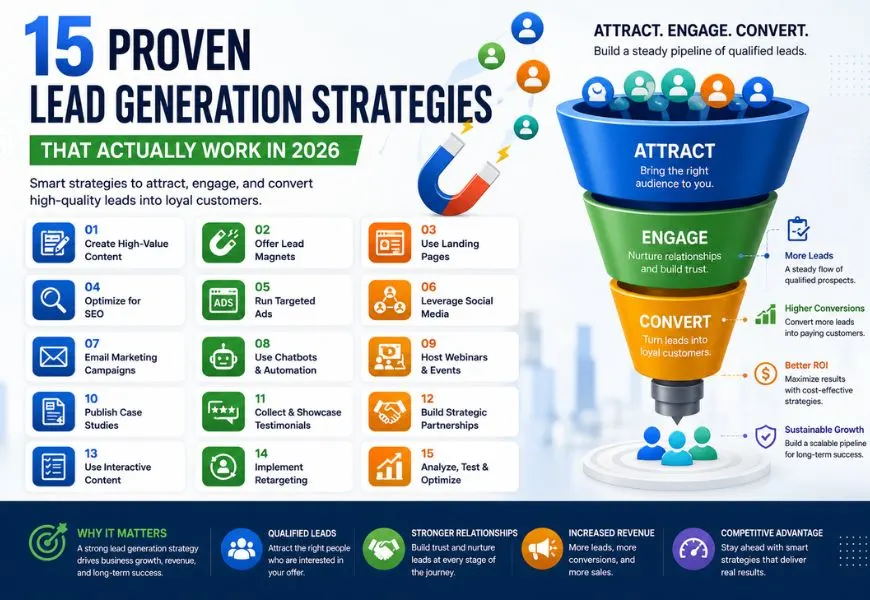
This guide explores 15 proven lead generation strategies that are delivering real results in 2026.
What Is Lead Generation?
Lead generation is the process of attracting and converting potential customers who have shown interest in your products or services.
A lead may come from:
- Website inquiries
- Contact forms
- Social media interactions
- Email subscriptions
- Phone calls
- Webinar registrations
- Downloadable resources
The goal is to move prospects through the sales funnel until they become paying customers.
Why Lead Generation Matters in 2026
Consumer buying journeys have become more complex. Most customers research online, compare options, read reviews, and interact with multiple touchpoints before making a purchase decision.
A strong lead generation strategy helps businesses:
- Build a predictable sales pipeline
- Increase revenue opportunities
- Improve marketing ROI
- Strengthen brand awareness
- Reduce customer acquisition costs
Let’s explore the most effective lead generation strategies for 2026.
1. Optimize for AI Search and AEO
With Google’s AI Overviews and AI-powered search becoming mainstream, businesses must optimize content for Answer Engine Optimization (AEO).
Create content that:
- Answers specific questions
- Uses clear headings
- Includes FAQs
- Targets conversational searches
Businesses appearing in AI-generated answers often receive highly qualified traffic.
2. Invest in Local SEO
Local SEO remains one of the highest-converting lead generation channels.
Optimize:
- Google Business Profile
- Local keywords
- Customer reviews
- Location-based landing pages
When users search for services “near me,” your business becomes easier to discover.
3. Create High-Value Blog Content
Content marketing continues to drive long-term lead generation.
Publish articles that solve customer problems, such as:
- Industry guides
- How-to articles
- Comparison posts
- Case studies
Educational content builds trust and attracts prospects during the research stage.
4. Offer Lead Magnets
People are more likely to share contact information when they receive value in return.
Popular lead magnets include:
- eBooks
- Checklists
- Templates
- Industry reports
- Free tools
A compelling lead magnet can significantly increase conversion rates.
5. Use Landing Pages for Every Campaign
Sending traffic to a generic homepage often reduces conversions.
Dedicated landing pages should include:
- Clear value proposition
- Strong call-to-action
- Minimal distractions
- Lead capture form
Focused landing pages convert better than standard website pages.
6. Run Google Ads
Google Ads helps businesses reach users actively searching for solutions.
Benefits include:
- Immediate visibility
- High-intent traffic
- Measurable results
- Fast lead generation
Combining SEO and PPC often delivers the strongest results.
7. Leverage LinkedIn for B2B Leads
LinkedIn remains one of the most powerful lead generation platforms for B2B companies.
Effective tactics include:
- Thought leadership content
- Networking
- LinkedIn Ads
- Direct outreach
- Industry engagement
Decision-makers are highly active on the platform.
8. Implement Marketing Automation
Marketing automation helps nurture leads without manual effort.
Automate:
- Welcome emails
- Follow-up sequences
- Lead scoring
- Customer journeys
Automation improves efficiency while increasing conversion opportunities.
9. Host Webinars and Online Events
Educational webinars help businesses showcase expertise while collecting qualified leads.
Topics should address:
- Industry trends
- Common challenges
- Practical solutions
- Product demonstrations
Attendees often represent highly interested prospects.
10. Use Video Marketing
Video continues to dominate digital engagement.
Lead-generating video formats include:
- Product demos
- Tutorials
- Customer testimonials
- Expert interviews
Videos build trust faster than text-based content alone.
11. Encourage Customer Reviews
Online reviews influence purchasing decisions more than ever.
Positive reviews help:
- Build credibility
- Improve local SEO
- Increase conversions
- Strengthen trust
Actively request reviews from satisfied customers.
12. Create Interactive Content
Interactive content keeps visitors engaged and captures valuable information.
Examples include:
- Calculators
- Assessments
- Quizzes
- Surveys
Interactive experiences often generate higher engagement rates than static content.
13. Optimize Website Conversion Rates
Increasing website traffic means little if visitors do not convert.
Conversion Rate Optimization (CRO) strategies include:
- Faster page speed
- Better calls-to-action
- Simplified forms
- Mobile optimization
- Trust signals
Small improvements can significantly increase lead volume.
14. Use Retargeting Campaigns
Most visitors do not convert during their first visit.
Retargeting helps bring them back through:
- Google Display Ads
- Facebook Ads
- Instagram Ads
- LinkedIn Ads
These campaigns keep your brand top-of-mind.
15. Build an Email Marketing Funnel
Email marketing remains one of the highest ROI channels available.
A successful funnel includes:
- Welcome sequence
- Educational content
- Promotional offers
- Customer success stories
Email nurturing helps convert prospects into customers over time.
Measuring Lead Generation Success
Tracking performance is essential.
Key metrics include:
- Lead volume
- Conversion rate
- Cost per lead (CPL)
- Customer acquisition cost (CAC)
- Lead-to-customer rate
- Return on investment (ROI)
Data-driven decisions help optimize campaigns and maximize results.
Common Lead Generation Mistakes to Avoid
Many businesses struggle because they:
- Ignore follow-up processes
- Target the wrong audience
- Use weak calls-to-action
- Neglect mobile optimization
- Focus on quantity over quality
- Fail to measure results
Avoiding these mistakes can significantly improve lead quality and conversions.
Final Thoughts
Successful lead generation in 2026 requires a strategic mix of SEO, AI search optimization, content marketing, paid advertising, automation, and conversion optimization. Businesses that focus on providing value, understanding customer intent, and creating seamless user experiences will consistently outperform competitors.
Rather than relying on a single channel, combine multiple lead generation strategies to create a sustainable pipeline of qualified prospects. By continuously testing, measuring, and improving your approach, you can generate more leads, increase conversions, and achieve long-term business growth in an increasingly competitive digital marketplace.
FAQs
- What is the most effective lead generation strategy in 2026?
A combination of SEO, AI search optimization, content marketing, paid advertising, and marketing automation typically produces the best results.
- How long does lead generation take to show results?
Paid advertising can generate leads immediately, while SEO and content marketing generally require three to six months to deliver consistent results.
- What is a qualified lead?
A qualified lead is a prospect who has shown genuine interest in your product or service and matches your target customer profile.
- Why is content marketing important for lead generation?
Content marketing builds trust, educates potential customers, improves search visibility, and attracts prospects throughout the buying journey.
- How can small businesses generate more leads on a budget?
Small businesses can focus on local SEO, content marketing, email marketing, customer referrals, and social media engagement to generate leads cost-effectively.