
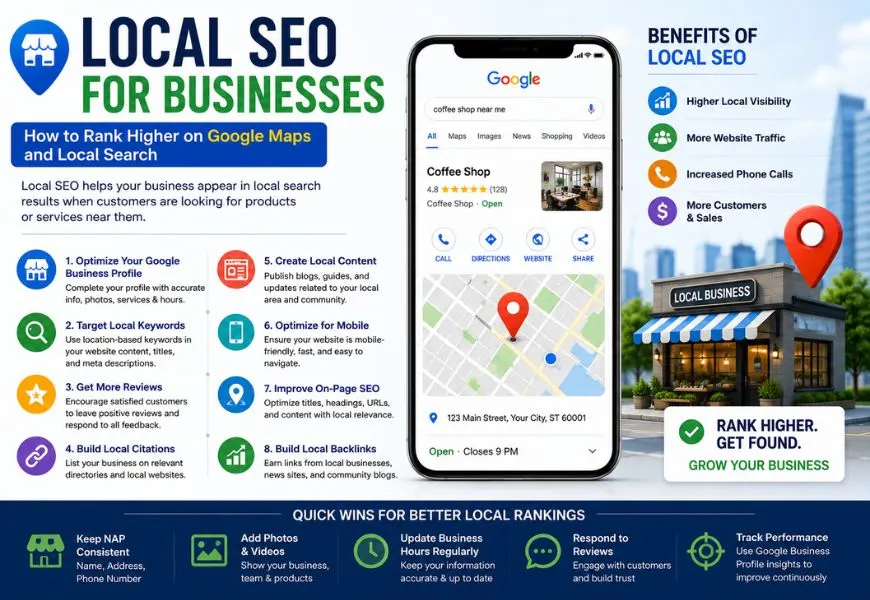
In today’s digital-first world, customers often search online before visiting a business. Whether they’re looking for a restaurant, clinic, law firm, retail store, or digital marketing agency, most people start with Google Search or Google Maps. If your business isn’t appearing in local search results, you’re missing valuable opportunities to attract nearby customers.
This is why local SEO for businesses has become one of the most effective digital marketing strategies in 2026. Local SEO helps businesses improve their visibility in location-based searches, drive more website traffic, generate qualified leads, and increase foot traffic to physical locations.
In this guide, you’ll learn how local SEO works and the proven strategies that can help your business rank higher on Google Maps and local search results.
What Is Local SEO?
Local SEO (Search Engine Optimization) is the process of optimizing your online presence to improve visibility in local search results.
When users search for phrases like:
- “Digital marketing agency near me”
- “Best dentist in Chennai”
- “Coffee shop nearby”
- “SEO services in Chennai”
Google displays local results based on relevance, distance, and prominence.
Local SEO helps ensure your business appears in these results when potential customers are actively searching for your products or services.
Why Local SEO Matters for Businesses
Local searches often have strong purchase intent. People searching for local businesses are usually ready to take action, whether that’s making a call, booking an appointment, or visiting a store.
Benefits of local SEO include:
- Increased visibility on Google Maps
- More website traffic
- Higher-quality leads
- Improved brand credibility
- More phone calls and inquiries
- Increased foot traffic to physical locations
Businesses that invest in local SEO gain a significant advantage over competitors who rely solely on traditional marketing.
How Google Determines Local Rankings
Google uses three primary factors when ranking businesses in local search results:
1. Relevance
How closely your business matches the user’s search query.
2. Distance
How close your business is to the searcher’s location.
3. Prominence
How well-known and trusted your business appears online.
Your local SEO strategy should focus on improving all three ranking factors.
10 Proven Local SEO Strategies for Businesses
1. Optimize Your Google Business Profile
Your Google Business Profile (formerly Google My Business) is the foundation of local SEO.
Ensure your profile includes:
- Accurate business name
- Address
- Phone number
- Website URL
- Business hours
- Services offered
- High-quality images
A fully optimized profile increases your chances of appearing in Google Maps and local search results.
2. Maintain Consistent NAP Information
NAP stands for:
- Name
- Address
- Phone Number
Your NAP details should be identical across:
- Website
- Business directories
- Social media profiles
- Local listings
Consistency helps Google trust your business information.
3. Collect and Manage Customer Reviews
Reviews play a major role in local search rankings.
Encourage satisfied customers to leave reviews on Google and other relevant platforms.
Benefits of positive reviews include:
- Improved local rankings
- Increased customer trust
- Higher click-through rates
- Better conversion rates
Responding to reviews also demonstrates engagement and professionalism.
4. Target Local Keywords
Use location-specific keywords throughout your website content.
Examples:
- Local SEO services in Chennai
- Digital marketing agency in Chennai
- Best dental clinic in Chennai
Include these keywords naturally in:
- Page titles
- Meta descriptions
- Headings
- Service pages
- Blog content
This helps Google understand your service area.
5. Create Location-Specific Landing Pages
Businesses serving multiple areas should create dedicated landing pages for each location.
For example:
- SEO Services in Chennai
- SEO Services in Coimbatore
- SEO Services in Bangalore
Each page should contain unique, locally relevant content.
6. Optimize for Mobile Users
Most local searches occur on mobile devices.
Ensure your website offers:
- Fast loading speed
- Mobile-friendly design
- Easy navigation
- Click-to-call functionality
A poor mobile experience can negatively impact both rankings and conversions.
7. Build Local Citations
Local citations are online mentions of your business information.
Popular citation sources include:
- Business directories
- Industry directories
- Local chambers of commerce
- Review websites
Citations help improve credibility and strengthen local search signals.
8. Publish Locally Relevant Content
Content marketing supports local SEO by demonstrating relevance to your community.
Examples include:
- Local event coverage
- Community involvement updates
- Industry news affecting your region
- Area-specific service guides
Locally focused content helps attract nearby customers.
9. Implement Local Business Schema
Schema markup helps search engines better understand your business details.
Important schema information includes:
- Business name
- Address
- Phone number
- Opening hours
- Reviews
- Geographic location
Structured data can improve search visibility and increase the likelihood of rich results.
10. Build High-Quality Local Backlinks
Backlinks remain an important ranking factor.
Earn links from:
- Local news websites
- Industry associations
- Community organizations
- Business partners
- Local blogs
Quality local backlinks strengthen authority and improve local rankings.
Common Local SEO Mistakes to Avoid
Many businesses fail to maximize local search visibility because they:
- Leave Google Business Profiles incomplete
- Use inconsistent NAP information
- Ignore customer reviews
- Target overly broad keywords
- Neglect mobile optimization
- Fail to create location-specific content
Avoiding these mistakes can significantly improve your local search performance.
How to Measure Local SEO Success
Track these key metrics:
- Google Business Profile views
- Website traffic from local searches
- Phone calls generated
- Direction requests
- Customer reviews
- Keyword rankings
- Lead conversions
Regular monitoring helps identify opportunities for improvement and growth.
Final Thoughts
As consumers increasingly rely on Google Search and Google Maps to find nearby services, investing in local SEO for businesses is no longer optional—it’s essential. A strong local SEO strategy helps businesses improve visibility, attract qualified leads, build trust, and increase conversions.
By optimizing your Google Business Profile, targeting local keywords, collecting customer reviews, creating location-specific content, and maintaining consistent business information across the web, you can significantly improve your local search rankings.
Businesses that prioritize local SEO today will be better positioned to dominate Google Maps, capture local customers, and achieve sustainable growth in 2026 and beyond.
FAQs
- What is local SEO for businesses?
Local SEO is the process of optimizing a business’s online presence to improve visibility in location-based search results on Google Search and Google Maps.
- Why is Google Business Profile important for local SEO?
Google Business Profile helps Google understand your business information and is one of the most important factors influencing local search rankings.
- How long does local SEO take to show results?
Most businesses begin seeing noticeable improvements within three to six months, depending on competition and optimization efforts.
- Do customer reviews affect local SEO rankings?
Yes. Reviews influence both rankings and customer trust. Positive reviews and active review management can improve local visibility.
- Can local SEO help service-based businesses?
Absolutely. Service providers such as consultants, agencies, healthcare clinics, law firms, and contractors can use local SEO to attract customers within their target geographic areas.